


AI in corporate travel reliably automates three things in 2026: policy checking at the point of booking, expense receipt matching and audit, and routine approval routing. It assists with disruption rebooking and itinerary building, where a human still approves. It does not yet handle complex reissues, NDC servicing, or supplier negotiation.
Key takeaways
- 61% of travel businesses are experimenting with or scaling agentic AI, but only 6% are scaling it across multiple functions (ITB Berlin, February 2026). Most of that 61% is experimentation, not production.
- Global business travel spending is forecast to reach $1.71 trillion in 2026 across 1.84 billion trips (GBTA Business Travel Index, 2026), but trip volume is growing at only 1.3%. Margin now comes from cost per transaction, not volume.
- New Distribution Capability (NDC), the IATA standard that lets airlines distribute fares and ancillaries straight into booking channels, now carries real volume. Yet 37% of corporate programmes made zero NDC bookings and 54% of travel managers said their TMC could not adequately support it (GBTA).
- The automation gap is not in booking. It is in servicing, and servicing is where TMCs make their money.
What tasks can AI automate in corporate travel?
AI automates high-volume, rule-bound tasks where the correct answer is checkable against a policy or a data source. It assists on tasks that need judgement across incomplete information. It fails on tasks that require negotiation, exception handling, or servicing across systems that do not talk to each other.
Most vendor content flattens this into one claim. The standard framing lists six or seven areas where AI is automating corporate travel: booking, cost control, expense, traveller safety, policy and reporting. That is directionally true and operationally useless, because it treats a fully automated receipt match and a partially automated disruption rebooking as the same kind of thing.
They are not the same kind of thing. One runs unattended. The other breaks if nobody is watching.
| Tier | Definition | Examples in 2026 |
|---|---|---|
| Tier 1: Automated | Runs without a human in the loop | Policy checks at booking, receipt matching, expense audit, approval routing, unused ticket tracking |
| Tier 2: AI-assisted | AI proposes, a human approves before execution | Disruption rebooking, multi-leg itinerary construction, email request parsing, fare re-shopping |
| Tier 3: Manual | AI provides little or no working lift | Complex reissues, NDC servicing and exchanges, supplier negotiation, duty of care escalation, GST and BSP edge cases |
Every claim below sits in one of these three tiers. If a vendor cannot tell you which tier a feature belongs to, the feature is Tier 2 being sold as Tier 1.
Tier 1: What AI fully automates today
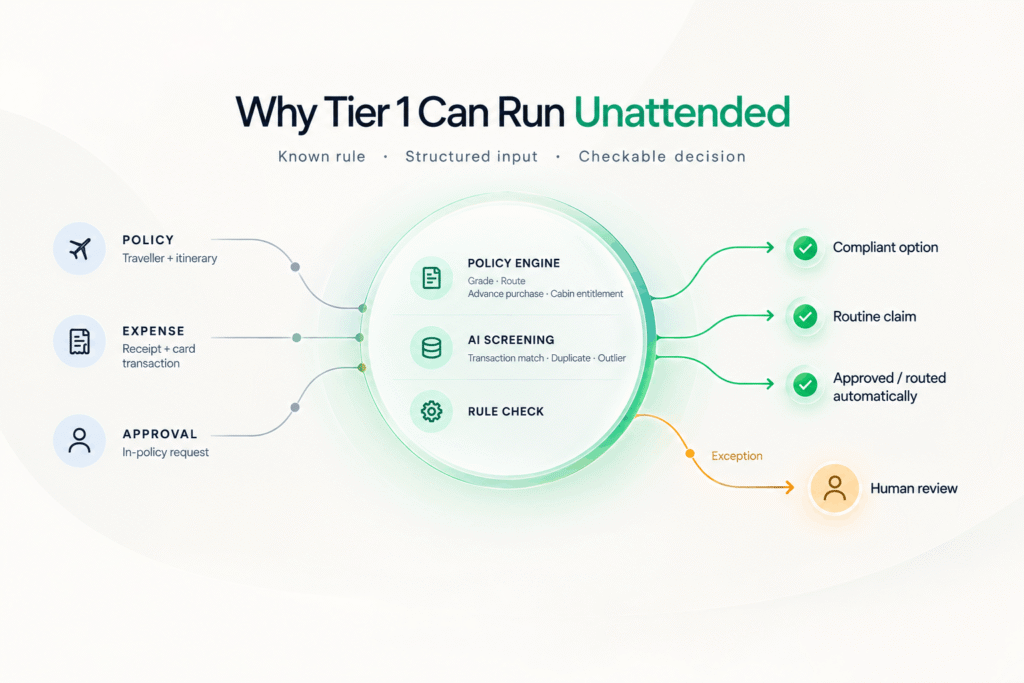
Three functions now run unattended in production systems: policy enforcement at the point of booking, expense receipt screening, and approval routing for in-policy requests. These share a property. The rule is known in advance, the input is structured, and a wrong answer is cheap to correct.
Can AI enforce a corporate travel policy automatically?
Yes, at the point of booking, for rule-based policy. The system knows the traveller’s grade, route, advance-purchase window and cabin entitlement, and filters non-compliant options out of the display before the traveller sees them. This is the most mature AI automation in corporate travel and the one with the clearest measurable outcome.
The shift is from post-hoc review to pre-emptive filtering. A travel manager used to audit a sample of bookings after the fact and chase violations. A policy engine applies the rule at search time, so the violation never gets created.
Where it still breaks: multi-entity policies, matrix-managed approvals, and any policy written in prose rather than rules. If your policy says “reasonable expenses at manager’s discretion”, no engine can enforce it.
How does AI automate expense reporting for business travel?
AI now reads receipts, matches line items to card transactions, flags duplicates and outliers, and screens every claim rather than a sample. The human step moves from checking everything to checking only what was flagged.
Amadeus reports that with its Smart Audit layer, 100% of expense reports with receipts are screened automatically so auditors only review claims that need a second look. That is a vendor claim about a vendor product, and it should be read as one. The underlying capability is not contested: receipt OCR plus transaction matching is a solved problem in 2026.
Industry forecasts expect the next step to be AI agents approving or rejecting claims outright, turning finance review into a set of parallel digital reviewers. That has not happened at scale yet. Approval is still Tier 2.
Does AI automate travel approval workflows?
For in-policy requests, yes. An approval that only confirms a rule has already been satisfied is a rubber stamp, and AI removes the wait. Amadeus found AI automating repetitive tasks such as policy queries, approvals and disruption management, freeing travel managers for forecasting and risk work.
Out-of-policy requests still route to a human, correctly. The value is not that approvals disappear. It is that a manager sees three exceptions a week instead of forty requests.
Tier 2: What AI assists with, under human approval
This tier is where most 2026 deployments actually sit, and where most marketing overstates. The AI does real work, produces a real output, and hands it to a person who presses the button. Industry research reported by ITB Berlin in February 2026 found 61% of travel businesses experimenting with or scaling agentic AI, but only 6% scaling it across multiple domains and functions.
That gap between 61% and 6% is the whole story of AI in corporate travel in 2026.
How does AI handle travel disruption and rebooking?
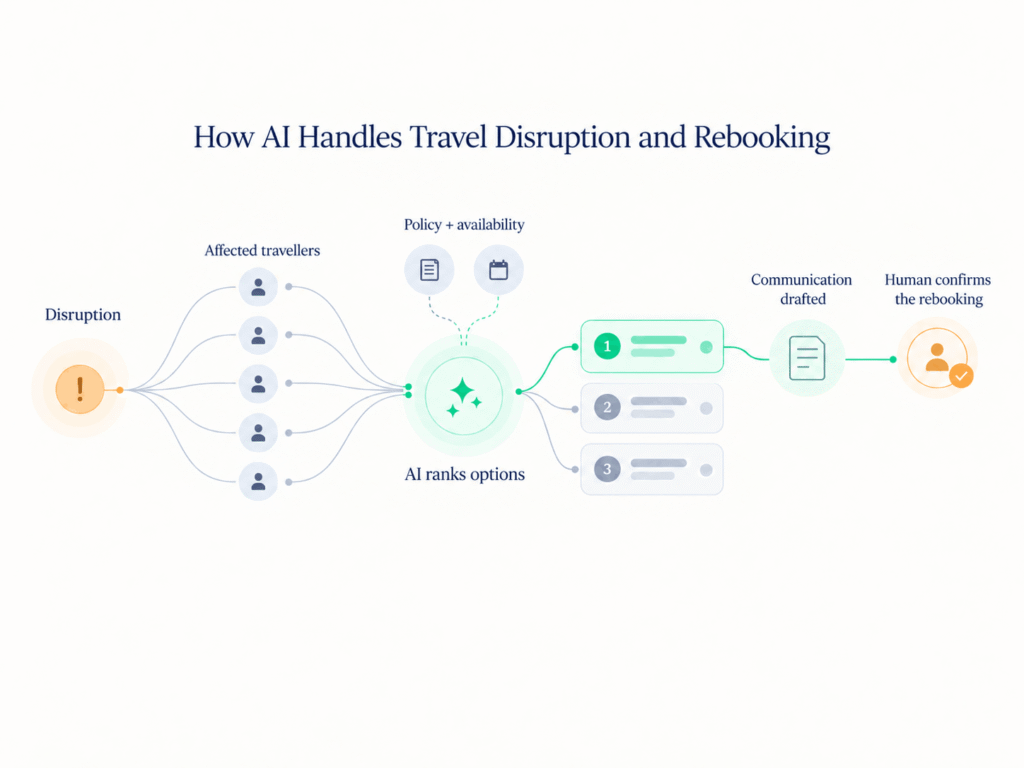
AI identifies affected travellers, ranks rebooking options against policy and availability, and drafts the traveller communication. A human confirms the rebooking. Full autonomy exists in demos and in narrow, single-carrier scenarios, not across an estate that mixes NDC content with fares from a global distribution system (GDS), the legacy pipe most agency bookings still run through.
The reason is not model capability. It is that a wrong rebooking during irregular operations costs a client relationship, and the systems needed to reverse it cleanly do not exist in most TMC stacks.
Traveller behaviour points the same way. More travellers now use AI during planning, but far fewer will let it complete the booking. That reluctance is stronger in managed travel, where the booking is not the traveller’s own money.
What is agentic AI in corporate travel?
Agentic AI describes systems that execute multi-step tasks across connected systems rather than producing text. The working definition in the industry is a system that autonomously performs complex tasks using real-time data, integrations and defined objectives. In corporate travel that means parsing a request, searching inventory, applying policy and producing a bookable itinerary without step-by-step instruction.
The same research found 62% of travel companies expecting technology budgets to increase in 2026, with generative and agentic AI the leading destination for that spend.
The enabling change was plumbing, not intelligence. The rapid adoption of model context protocol, an open standard for connecting AI applications to external systems, is what made agentic workflows practical without bespoke integration work for every connection.
How much human oversight does AI booking need?
More than vendors imply and less than sceptics assume. The working pattern in 2026 is AI-generated options with human confirmation, and the oversight burden scales with transaction value and itinerary complexity, not with volume.
Amadeus concluded that organisations combining AI with strong governance, security and oversight are best positioned to benefit, and that adoption depends on building trusted foundations. Read plainly, that is a technology vendor saying the technology is ahead of the controls around it.
Design the approval thresholds before deployment. A system that asks for approval on everything gets ignored, and one that asks for nothing gets switched off after the first bad booking.
Tier 3: What is still manual in 2026
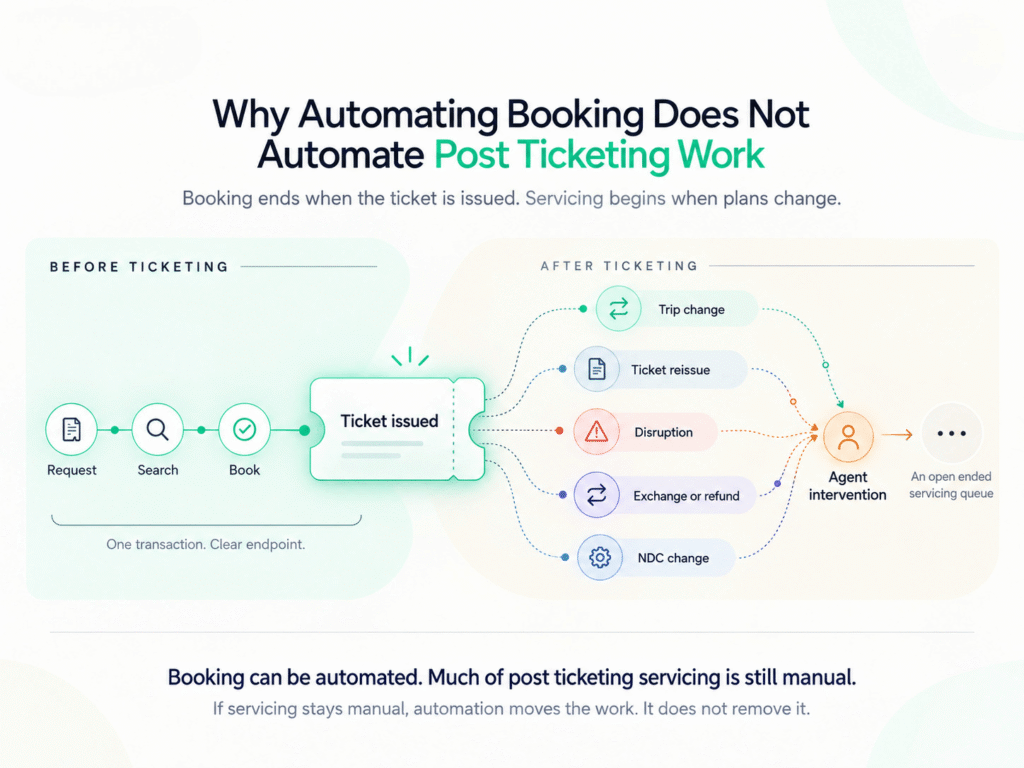
Servicing is still manual, and servicing is where TMC margin lives. Complex reissues, meaning changes to an already-ticketed itinerary, along with NDC exchanges and mid-trip changes across mixed content, still consume agent time at close to pre-AI rates. This is the least discussed part of the AI story and the most expensive.
What can AI not do in corporate travel?
It cannot service what it cannot reach. NDC illustrates the problem exactly. NDC reached around 24% of indirect airline ticket sales globally in Q1 2026, with European penetration at 31% against North America’s 18%, so the content is genuinely there.
The servicing behind it is not. A GBTA survey found only 13% of travel managers in the US and Canada say their online booking tools allow them to self-service NDC changes. The same body found 54% of travel managers saying their TMC could not adequately support NDC, and 37% of programmers making no NDC bookings at all.
No AI layer fixes this, because the constraint is API coverage and exchange logic, not reasoning. An agent still opens a second interface and does it by hand.
Why do corporate bookings still need a human agent?
Because the exceptions are where the value is. Rate negotiation, escalation during a security event, a visa problem at 2am, a CFO asking why a specific fare was chosen: none of these are pattern-matching tasks, and all of them are why a corporate client pays a management fee rather than using a consumer booking site.
As one distribution analyst put it, TMCs make money by servicing bookings. Automating the booking while leaving servicing untouched moves cost, it does not remove it.
Which manual task costs a TMC the most?
Post-ticketing servicing, by a wide margin. Under legacy distribution most servicing is handled by hand, and the call center headcount that absorbs it forms a large share of a traditional TMC’s cost base, as AltexSoft’s analysis of NDC adoption sets out. Booking is a single transaction. Servicing is an open-ended queue.
That asymmetry is why booking automation alone rarely shows up in margin. A TMC that halves search-and-book time while leaving the exchange queue untouched has moved effort, not removed cost. The saving appears on a slide and not in the accounts.
It also explains why vendor automation rates are so often quoted without a denominator. A rate measured across bookings looks impressive because bookings are the easy half. Ask for the same number measured across post-ticketing changes, and ask whether partial automation, where the system prepares the change and an agent completes it, is counted as automated. Most of the time it is.
The practical test is simple. Take last month’s servicing queue, count the items that closed with no human touch, and divide. That number is your real automation rate. Every other figure in a vendor deck is a subset of it.
Is AI replacing corporate travel managers?
No. It is removing the administrative half of the role and leaving the judgement half, which is the part the job was always supposed to be. Amadeus found the greatest impact of AI may be on the travel manager’s role, moving them from administrators of disconnected systems to orchestrators combining AI insight with human judgement across cost, compliance and duty of care.
Gemma King, Chair of the Board of Directors at the Institute of Travel Managers, put it more usefully than any vendor has: AI allows travel managers to become the conductor rather than the administrator. (The Business Travel Magazine)
The direction of travel is consistent across the 2026 research. Traveller trust in AI for routine travel and expense tasks has risen sharply year on year, while willingness to let AI complete a booking unsupervised has not moved at anything like the same rate. Those two curves separating is what defines the Tier 1 and Tier 2 boundary in practice.
How do TMCs use AI in 2026?
TMCs are deploying AI at the two ends of the workflow and leaving the middle alone. At intake, email and chat requests are parsed into structured search criteria. At output, quality control and reporting run automatically. Booking and servicing, the expensive middle, remain largely human.
The commercial logic is straightforward. GBTA projects 7.2% spend growth in 2026 against only 1.3% growth in trip volume. GBTA CEO Suzanne Neufang noted that companies haven’t stepped away from travel, but they are increasingly more selective and productivity-focused. (PhocusWire)
For a TMC, flat transaction volume with rising costs means margin has to come out of cost per booking. That is the entire business case for automation, and it is a different case from the traveller-experience story vendors lead with.
See our review of AI tools for TMCs and our comparison of corporate travel booking automation against manual booking.
Does AI in corporate travel work the same in every market?
No. The tier boundaries move by region, because the constraint is local process rather than model capability. The same platform that runs unattended in one market needs a human in three places in another.
Distribution maturity moves it first. Where airlines have pushed more content into NDC, a TMC hits the Tier 3 servicing wall sooner and harder, because a larger share of its bookings sits in a channel its tooling services badly. Readiness has not kept pace anywhere: 54% of travel managers said their TMC could not adequately support NDC, and only 13% said their booking tool let them self-service an NDC change.
Compliance moves the line further. Indian corporate travel carries multi-entity payment structures, decentralised approvals and GST on every transaction. ATPI notes that TMCs serving India need configuration for multi-entity payments, decentralised approvals and GST compliance, alongside unified access to GDS content, low-cost carriers and NDC. Gulf markets add their own invoicing and settlement rules.
These compliance steps are rule-bound and high-volume, which on the framework above makes them Tier 1 tasks. Almost none of them are automated, because global platforms build for the largest markets first. The gap between what is automatable and what is automated is widest exactly where the local rules are most specific.
The practical consequence: a vendor’s automation rate is a number from their largest market. Ask what it is in yours.
Where to start
Sort your own workflow into the three tiers before evaluating a single vendor. Most teams discover that their highest-volume manual task is Tier 1, and that the thing they were about to buy is Tier 2 sold as Tier 1.
Then ask every vendor one question: what percentage of transactions does this run without a human touching it? A real answer is a number. An answer about efficiency gains is not an answer.
Conclusion
AI in corporate travel in 2026 is a story about tiers, not about transformation. Policy, expense and approvals genuinely run themselves. Disruption handling and itinerary building work well with a human on the button. Servicing, reissues and NDC exchanges are still manual, and no amount of model capability changes that until the underlying content and API layers do. Buy for the tier you are actually in.
Talk to VantisCorp about your TMC
See how the workflows in this article could work for your operation. Share a few details and our team will follow up.
