

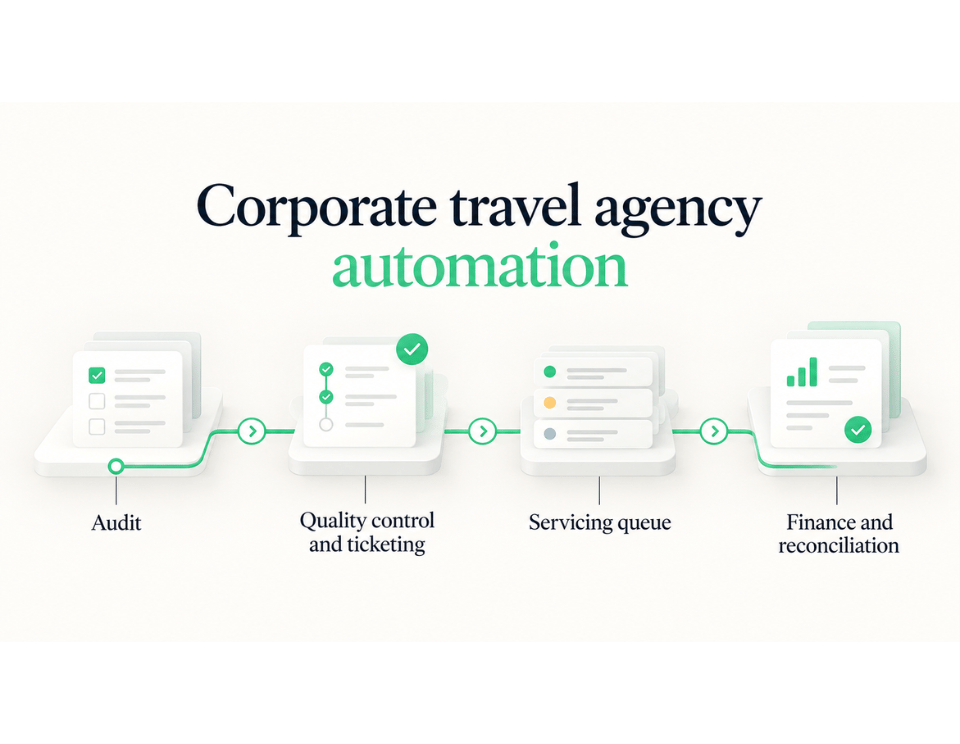
Start by measuring, not buying. Count your monthly volume by task type, work out which tasks follow a rule that is knowable in advance, and audit what your GDS already automates. Most TMCs find their biggest manual job is already covered by tooling they pay for. Sequence after that, never before.
Key takeaways
- Sequence by four things: how often a task happens, whether the rule is knowable in advance, whether you already own the capability, and what a wrong answer costs to unwind.
- Quality control and ticketing automate first. They are high volume, rule-bound, cheap to correct, and they sit upstream of everything else.
- Measure the result in agency debit memos avoided, not hours saved. An ADM is a real invoice with an administration fee attached. Hours saved is an estimate nobody can audit.
- The most expensive mistake is buying capability you already own. Every major GDS has shipped automated quality control, ticketing and exchanges for over a decade.
- Servicing hurts most and automates last. Starting there is why most automation programs stall.
Where corporate travel agency automation usually goes wrong
If you run a TMC, none of this will be news to you. You know which two people on your team handle anything complicated. You know the queue builds on a Friday afternoon. You know roughly what a schedule change costs you in agent time, even if nobody has ever written it down.
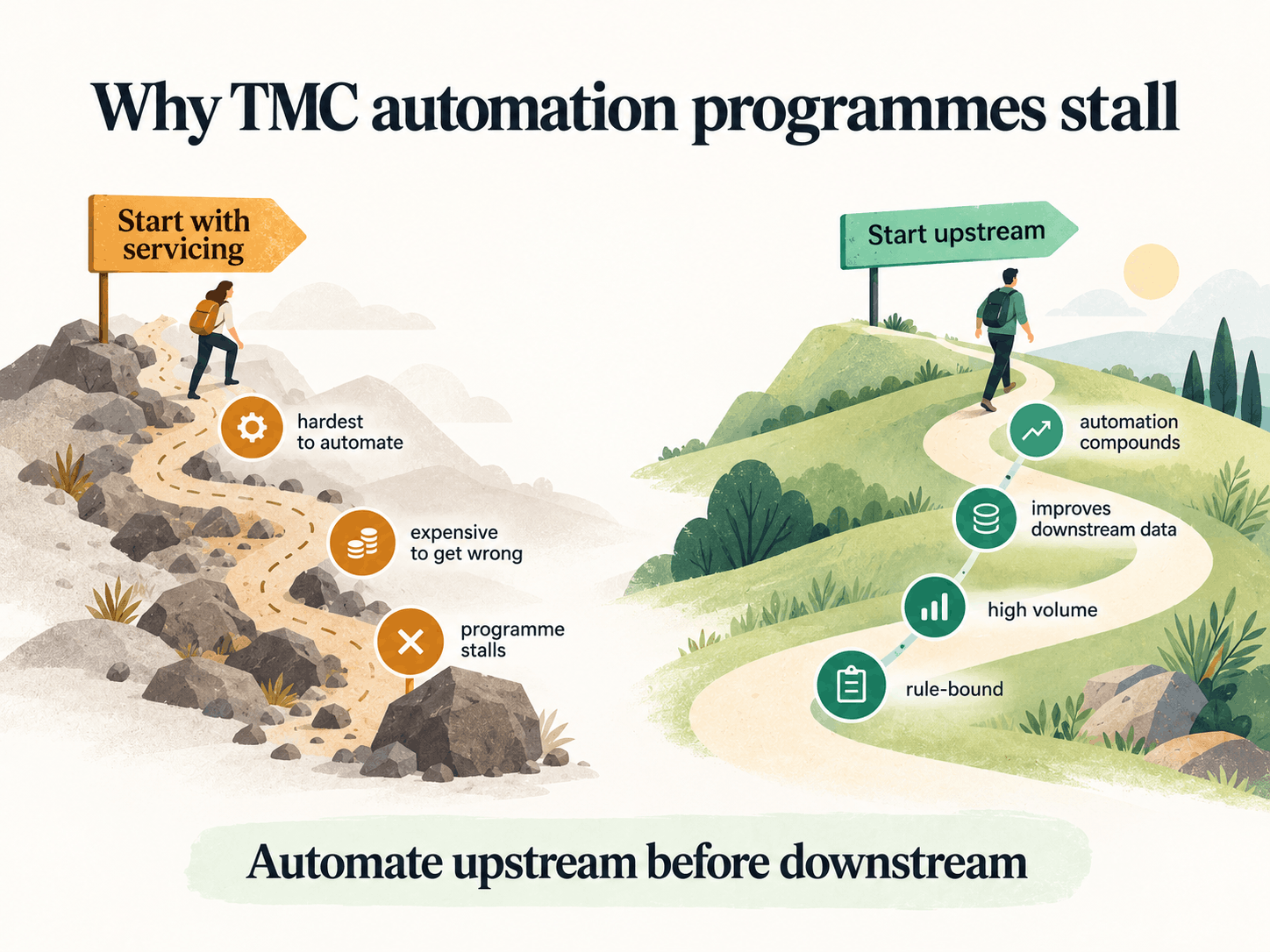
So the problem is not identifying the pain. It is that most automation advice tells you to start with your biggest pain point, and in a TMC the biggest pain point is servicing. Servicing is also the hardest thing to automate well, so teams start there, stall, and conclude that automation does not work for an operation like theirs.
It does work. The order is just wrong.
Automation compounds, and it compounds in one direction. Clean, validated data coming out of ticketing is what makes reconciliation automatable later. Reconciliation automated on top of messy ticketing data gives you the same errors, arriving faster. Connecting mid and back-office processes moves work from several minutes of manual entry and validation per transaction to almost entirely automated validation and correction before anything loads into the back office, as Cornerstone sets out in its analysis of mid and back-office connections. The order of operations is what makes that possible.
The rule is simple enough to keep in your head. Automate upstream before downstream. Automate the thing that produces data before the thing that consumes it.
Three numbers to get before you buy travel agency automation
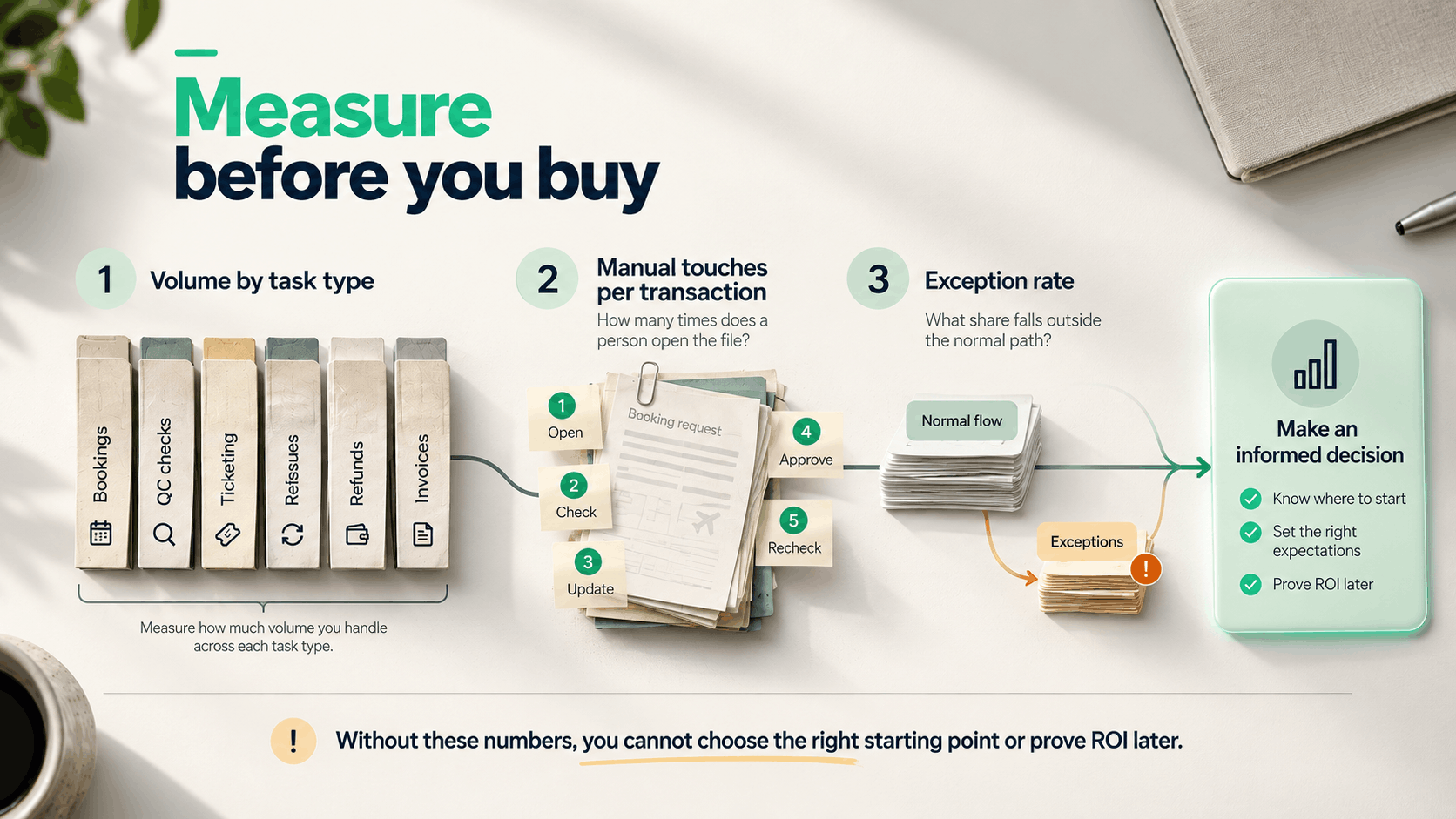
You need three numbers, and last month has all of them. Without these, every vendor conversation becomes a discussion about features, and you have no way to tell afterwards whether anything actually improved.
Volume by task type. Bookings, ticketing, quality control checks, reissues, refunds, invoices. Not a total. A breakdown, because the total tells you nothing about where to begin.
Manual touches per transaction. How many separate times a person opens a file for each kind of task. A booking that passes through three agents is a different problem from one that comes back to the same agent three times, and they need different fixes.
Exception rate. What share of each task type falls outside the normal path and needs someone experienced. This number predicts how much of a task is genuinely automatable, and it predicts it better than any demo will.
Most TMCs have never put these together. That is not a criticism of how the business is run. It is what happens when exception work arrives as interruptions rather than as a queue with a number attached to it. Work nobody counts does not get a business case, and work without a business case does not get fixed.
If you do nothing else from this article, spend a week getting these three numbers. They will change what you buy.
The four questions that decide what to automate first
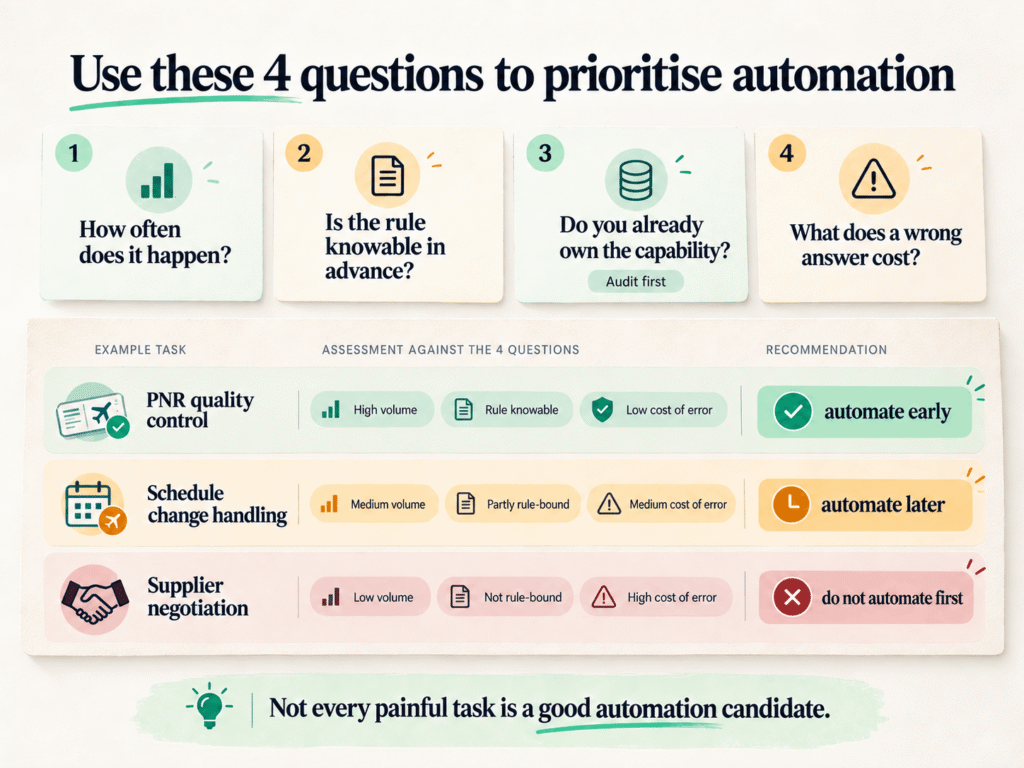
Run every candidate task through four questions. The answers give you a sequence without anyone needing an opinion about which platform is best, which is the part most automation plans skip. Skip it and you end up organised around vendor capability rather than around your operation.
How often does it happen? Volume multiplies everything else. A task that happens four hundred times a month and takes two minutes beats one that happens twice and takes an hour, every time.
Is the rule knowable in advance? If the right answer can be checked against a policy, a fare rule or a data source, it can run unattended. If it needs a judgement about a situation nobody structured, it can be assisted at best.
Do you already own the capability? Stage 1 below. This is the question that saves the most money and the one nobody in a sales process will raise for you.
What does a wrong answer cost? A mis-flagged quality check costs seconds. A wrong reissue costs a client relationship. The higher the cost of error, the more human confirmation you need in the design, and the less the automation actually saves you.
| Task | Volume | Rule knowable | Cost of error | Automate at |
|---|---|---|---|---|
| PNR quality control | High | Yes | Low | Stage 2 |
| Ticketing in-policy bookings | High | Yes | Low | Stage 2 |
| Itinerary distribution | High | Yes | Low | Stage 2 |
| Fare re-shopping | Medium | Yes | Low | Stage 2 |
| Reissue queue routing | Medium | Partly | Medium | Stage 3 |
| Schedule change handling | Medium | Partly | Medium | Stage 3 |
| Invoice generation | High | Yes | Medium | Stage 4 |
| BSP reconciliation | High | Yes | High | Stage 4 |
| Supplier negotiation | Low | No | High | Never |
Stage 1: Audit the GDS automation you already own
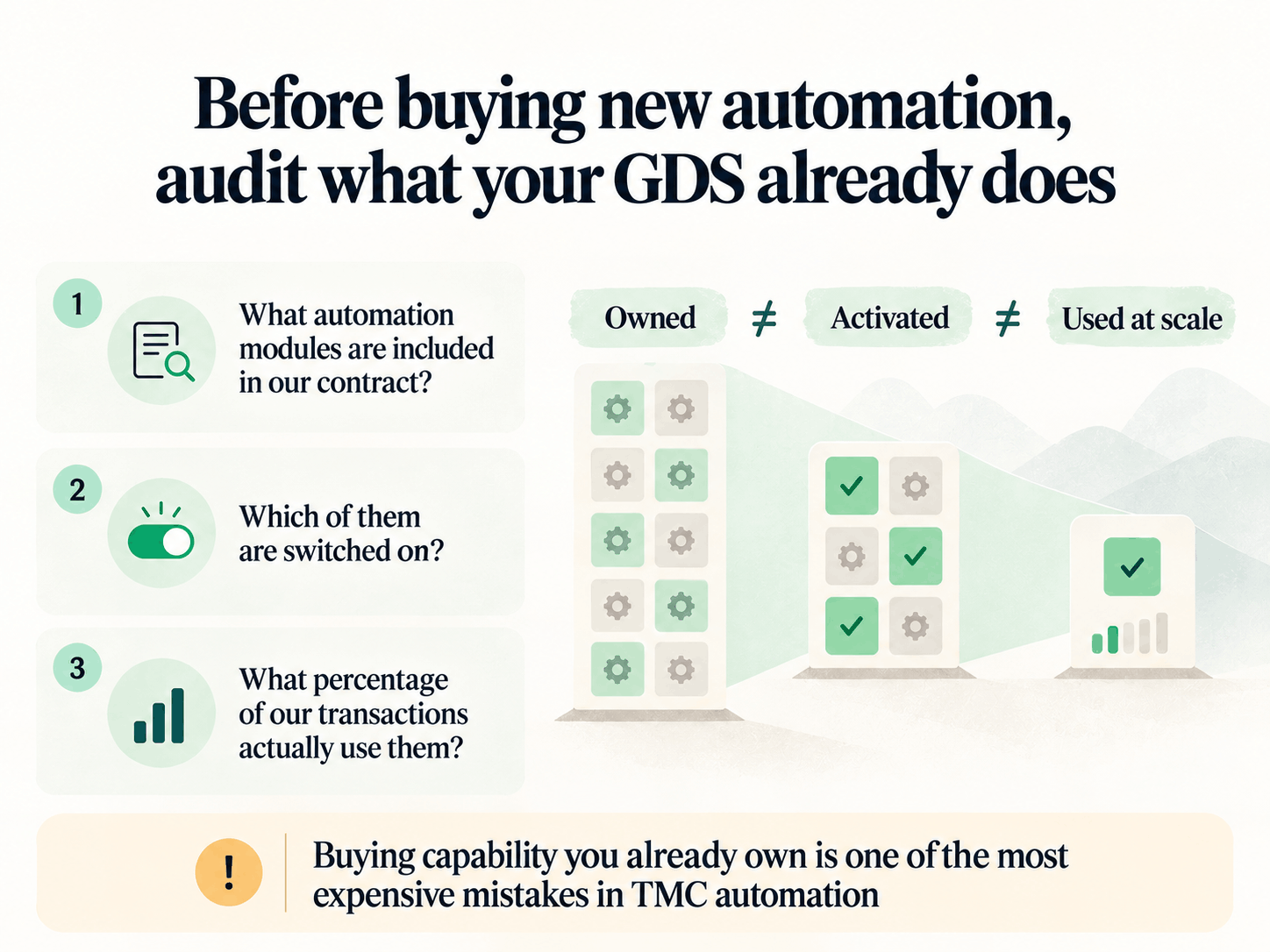
Before you evaluate anything, write down what your GDS already does. Automated quality control, automated ticketing, queue sorting and automated exchanges have shipped in the major GDSs for more than a decade. TMCs buy this capability twice more often than anyone likes to admit, and nobody in the sales conversation has a reason to stop you.
Ask your account manager three questions. Which automation modules are included in our current contract? Which of them are actually switched on? And what percentage of our transactions flow through them?
That third question is the one that matters, and it is the one that usually produces an uncomfortable pause. Owning a capability and using it are different states. The gap between them is nearly always a coverage or training problem rather than a tooling problem.
Here is why that distinction is worth caring about. If the automated path only handles six cases in ten, your agents keep the manual skill in daily use, and it stays their default. A tool that works most of the time gets treated as an exception tool, and exception tools do not change your cost base.
This stage takes a week and costs nothing. It routinely removes a line item from the automation budget before anyone has signed anything.
Stage 2: PNR quality control and ticketing automation
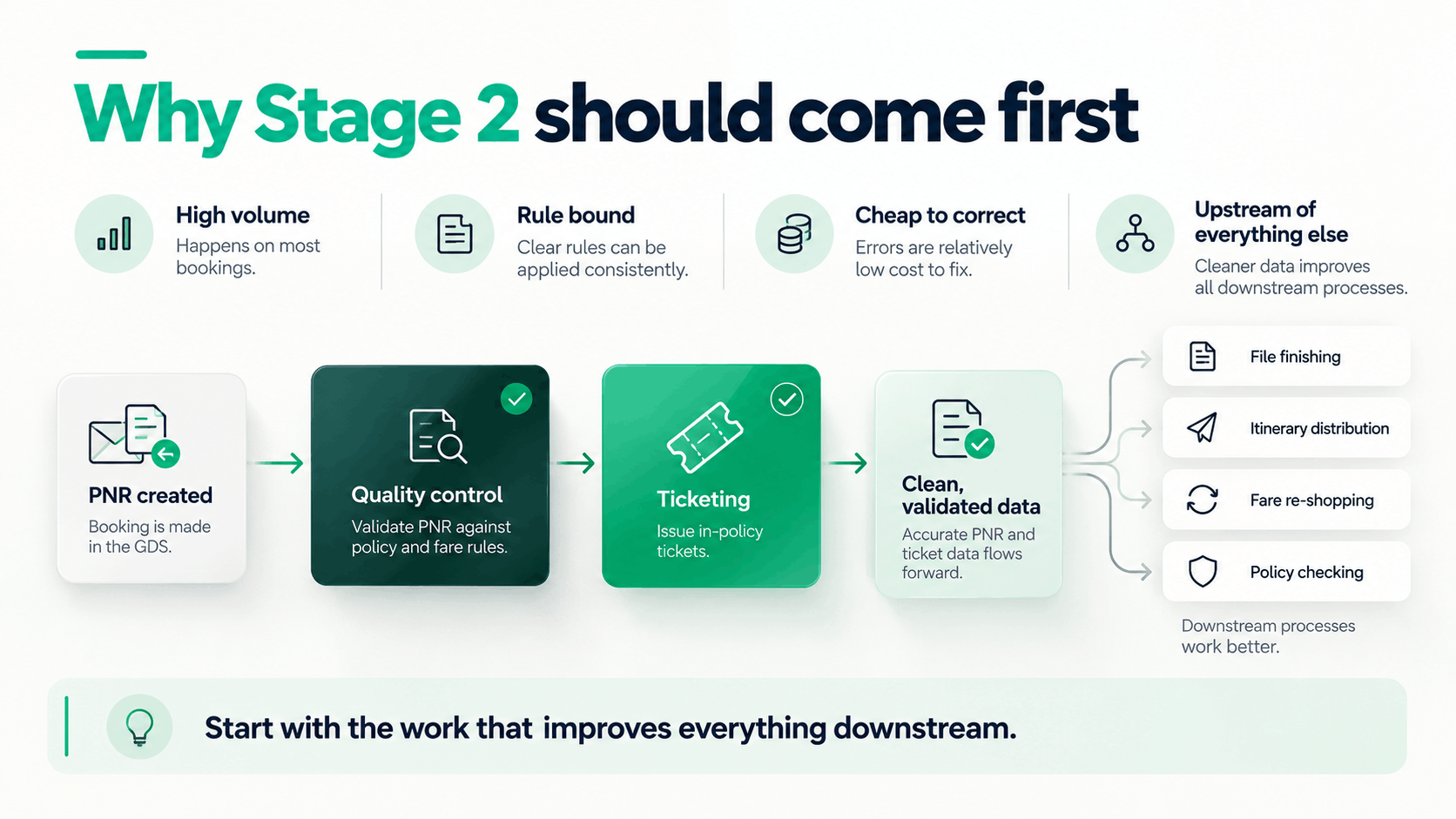
Start here. Quality control and ticketing are high volume, governed by rules known before the transaction happens, and cheap to fix when they go wrong. They also sit upstream, so automating them improves the data that everything downstream depends on.
Mid-office automation at this stage covers quality control, file finishing, preparing and emailing traveller itineraries, and re-shopping for lower fares inside the rebooking window, according to Business Travel News Europe. Policy checking belongs here too, comparing a traveller’s grade against the booking price to confirm it sits inside the limit for that level.
Fare re-shopping deserves a second look in 2026. Airline dynamic pricing means fares move between booking, ticketing and departure, and with average US agency ticket prices up 17% year on year to $624 in August 2026, the gap between what you booked and what is available has widened. Re-shopping is rule-bound, runs without an agent, and makes money rather than just saving time. It is the easiest business case in the whole programme.
Expect this stage to remove more manual hours than any other single thing you do.
Why agency debit memos are the number that proves it worked
Here is the part most automation conversations miss, and it is the one your finance director will care about.
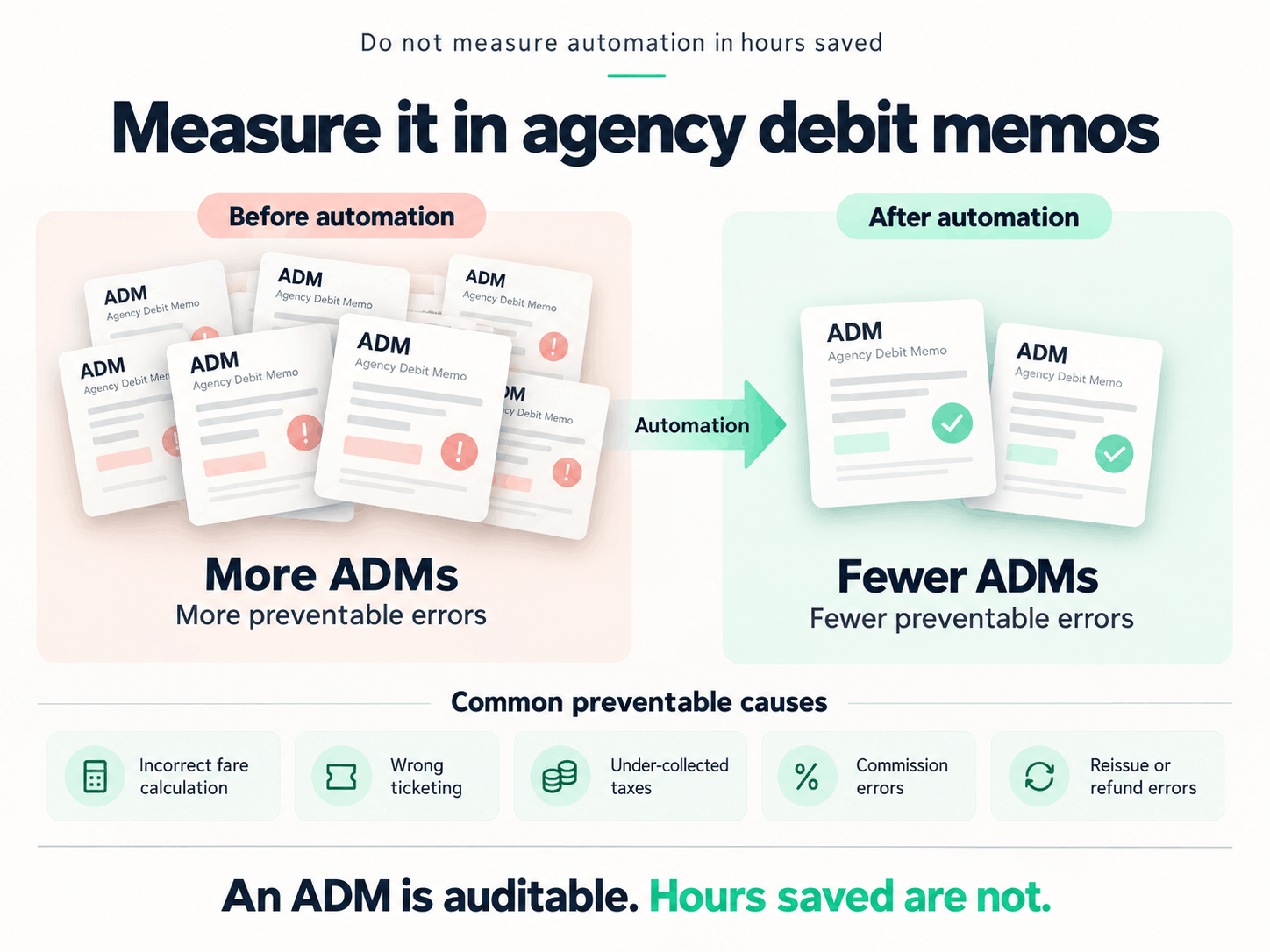
Every TMC measures automation in hours saved. Hours saved is soft. You cannot audit it, your board cannot verify it, and twelve months later nobody can tell you whether it happened. Agency debit memos are the opposite. An ADM is an invoice from an airline with a reason code and an administration fee attached, and it lands in BSPlink or ARC Memo Manager whether you were expecting it or not.
Look at what actually triggers them. Under IATA Resolution 850m, carriers raise ADMs for incorrect fare calculation, wrong ticketing, under-collected taxes, incorrectly claimed commission, class mismatch and reissue or refund errors. ANA’s 2026 policy lists non-compliance with reissue and exchange rules, incorrect refund calculation, wrong application of cancellation penalty and incorrect commission recall as separate categories.
Read that list again. Every item on it is a quality control failure. Every one of them is exactly what automated PNR checking, fare validation and commission handling exist to catch before ticketing.
The scale is not trivial either. Fares and taxes together with commissions made up 44% of all ADMs in a year analysed by ARC’s Debit Memo Working Group, and carriers were running so many different reason codes, some with over 500, that the group had to standardise the list down to 138 to make root causes identifiable at all. Disputing an ADM is not free either. Carriers apply an administration fee per memo, and some charge a further fee per dispute regardless of who turns out to be right.
So before Stage 2, count your ADMs for the last six months by reason code. After Stage 2, count them again. That is your automation ROI, in cash, with an audit trail. No estimate required.
Stage 3: Mid office automation for the servicing queue
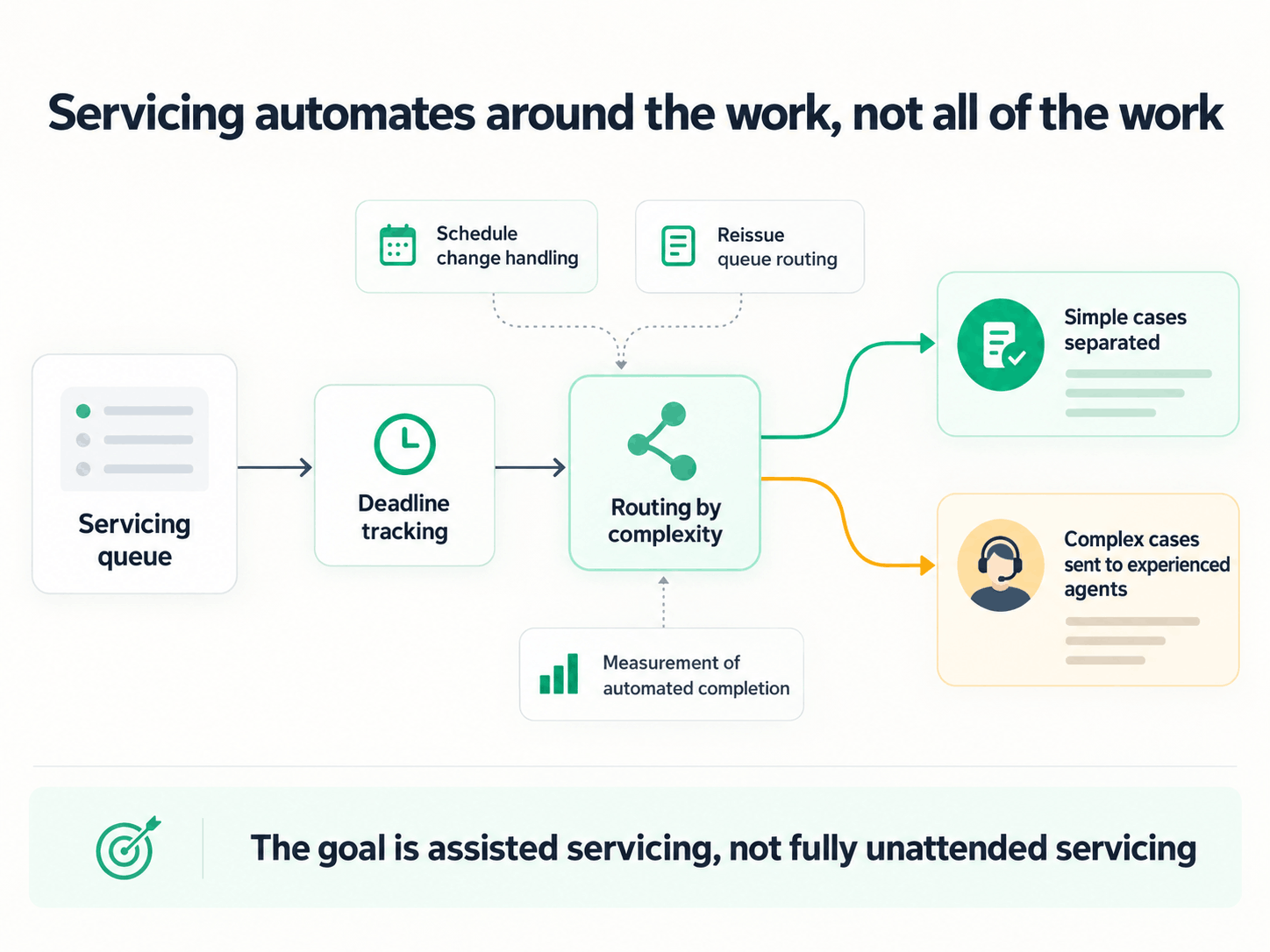
Servicing is where your margin sits and where automation is hardest, which is exactly why it comes third and not first. Reissues, exchanges, schedule changes and mid-trip amendments are only partly rule-bound and expensive to get wrong, so the realistic target here is assisted handling, not unattended processing.
What automates cleanly is the queue around the exchange rather than the exchange itself. Deadline tracking, where carriers push reissue deadline messages into the GDS and a missed one reprices the ticket upward. Routing by complexity, so the cases your automated path can finish are separated from the ones needing an experienced agent before anyone opens the file. And measurement, so you can answer how many reissues completed automatically last month.
The exchange transaction itself already has tooling in every GDS, with an agent confirming at the end. That design is right. An incorrect reissue is expensive to unwind, and with ticket prices where they are, it is more expensive than it was two years ago.
If a vendor tells you servicing runs fully unattended, ask what share of transactions that covers. The honest answer is never all of them.
Stage 4: Back office automation for finance and reconciliation
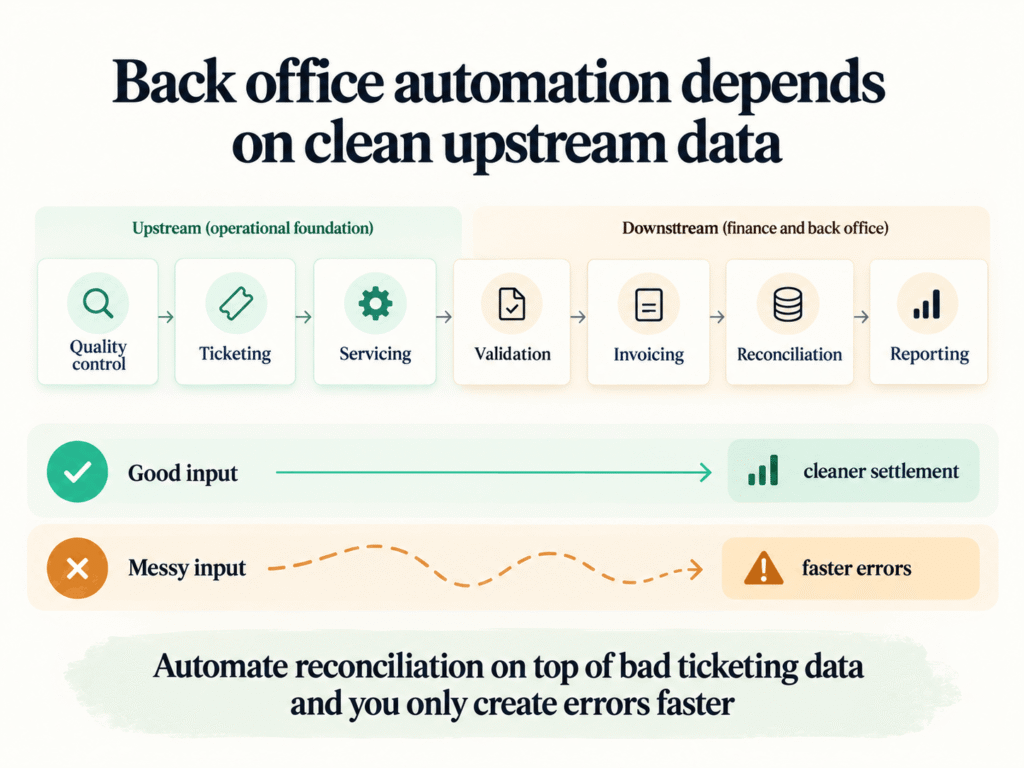
Invoicing, BSP settlement, commission recalculation and management reporting come last, because they consume the data every earlier stage produces. Automate reconciliation on top of unvalidated ticketing data and you will produce errors faster than a person would, and you will find out at settlement rather than at booking.
This stage also carries the highest cost of error, which changes how you design it. Validation gates matter more than speed here. The target is near-total automated validation and correction before anything loads into the back office, not fast processing of whatever turns up.
Scale makes the case on its own. ARC processes over $100 billion in US agency air sales annually across roughly 9,880 agency locations. A small error rate at settlement volume is expensive, and it is expensive in the worst way, which is quietly and months later.
The market is moving here. UK TMC Traveleads brought in a new mid and back-office partner specifically to centralise data from multiple suppliers across integrated accounts receivable, accounts payable and general ledger, as Travolution reported in 2026. Centralisation is the precondition for automating this stage at all.
What not to automate first in a TMC
Three categories consistently disappoint the teams that start with them. Knowing why will save you a year.
Anything that needs judgement about an unstructured situation. Supplier negotiation, escalation during a disruption, a visa problem at two in the morning. These are the things your clients pay a management fee for, and they are not pattern-matching problems.
Anything rare but highly visible. Complaints, VIP handling, bespoke itineraries. They feel important because everyone sees them, and they happen too infrequently for automation to return anything.
Client-facing communication, before the operation behind it works. Automate traveller messaging while your ticketing still produces errors and all you have done is automated the delivery of those errors to your client.
One warning specific to corporate travel. Some mid-office capability was designed for retail agencies and conflicts with a managed programme. Airfare markups are normal in retail and a problem in corporate, so Business Travel News Europe advises buyers to ask directly about markup and commission handling before signing. A platform built for leisure will cheerfully automate something your corporate client will object to in the first quarterly review.
How long does travel agency automation take?
Sequencing only works if you let each stage finish. Run them in parallel and you end up with partial coverage everywhere and full adoption nowhere, which is the state that convinces people automation does not work.
| Stage | Typical elapsed time | What done actually means |
|---|---|---|
| 1. Capability audit | One week | A written list of what is included, switched on, and genuinely used |
| 2. Quality control and ticketing | One to three months | Above 80% of eligible transactions flowing through the automated path |
| 3. Servicing queue | Three to six months | Deadline tracking complete, routing automatic |
| 4. Finance and reconciliation | Three to six months | Validation running before load, with exception reporting |
That 80% threshold in Stage 2 matters more than the timeline does. Below it, your agents keep the manual process as their default and the automation quietly becomes an exception tool. It is the most common reason these programmes stall, and it is a coverage problem, not a software problem.
Where VantisCorp fits in mid office automation
We build mid office automation for TMCs, white-labelled, so your clients only ever see your brand. Which means we are useful in Stages 2, 3 and 4, and deliberately not in Stage 1.
In Stage 2 that is PNR quality control, automated ticketing of in-policy bookings, file finishing and itinerary distribution. In Stage 3 it is reissue queue routing, deadline tracking and schedule change handling sitting alongside the exchange tooling you already have in your GDS. In Stage 4 it is invoicing, reconciliation and reporting, with validation running before anything loads.
On Stage 1 we would rather you did the audit first, even though it sometimes costs us the deal. A TMC that buys quality control automation while already paying for it inside a GDS contract ends up unhappy, and correctly so.
One boundary worth being straight about. Our booking agent, which reads corporate travel requests from an inbox and quotes back, is genuinely AI. Mid office and back office are conventional automation, and we do not describe them otherwise. Plenty of platforms in this market now label rule-based queue handling as AI. It sounds better and it makes the capability harder to evaluate.
Conclusion
Measure and audit before you buy anything. The sequence that works runs upstream to downstream: capability audit, then quality control and ticketing, then the servicing queue, then finance and reconciliation. Finish each stage before starting the next, and hold Stage 2 to an adoption threshold rather than a launch date. Then prove it in debit memos rather than in hours, because one of those numbers can be audited and the other cannot. Teams that start with servicing because it hurts the most usually stall there, and the stall is what persuades them automation was never going to work for an operation like theirs.
Talk to VantisCorp about your TMC
See how the workflows in this article could work for your operation. Share a few details and our team will follow up.
