


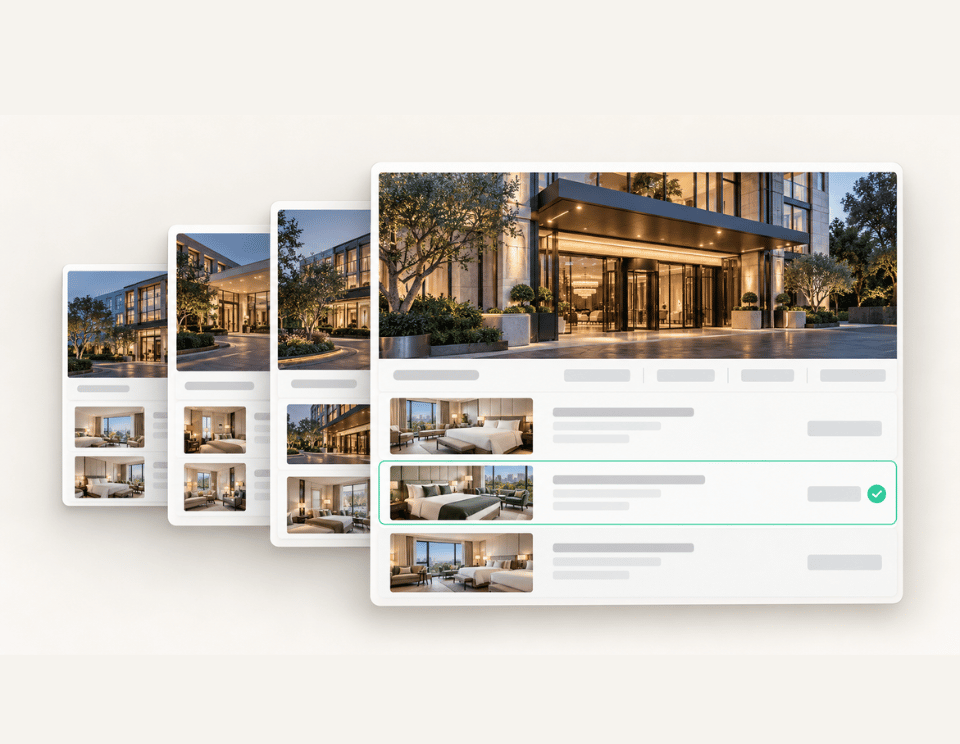
A hotel booking engine searches several hotel suppliers at once, merges the duplicate properties and rooms those suppliers return, applies your pricing rules, and confirms the booking with a voucher under your own brand. The search and the booking are the easy parts. Merging duplicates correctly is what separates a usable engine from one your agents stop trusting.
Key takeaways
- Hotel is roughly 30% of managed corporate travel spend, second only to air (GBTA 2025 Business Travel Index), and 83% of corporate programmes run on negotiated rate structures (GBTA).
- Around 32% of hotel bookings happen outside the managed channel, and hotel leakage grew or held steady in 81% of programmes (GBTA, 2026).
- 46% of buyers named booking-tool content gaps as a top-three operating headache for 2026, and 42% of travellers cite missing inventory as a reason they book elsewhere (GBTA).
- 18% of negotiated rates fail to load correctly into the GDS at contract start, and 11% of properties charge above the negotiated rate at least once in the contract year (BCD Travel, 2025).
- Four content sources feed most engines, and rate mapping, not search, is the hard problem. A corporate engine also has to carry each client’s own negotiated rates and rank by policy rather than price.
What is a hotel booking engine, and what does it actually do?
A hotel booking engine is the system that sits between your travellers and the hotel suppliers you have access to. It takes a search, queries several suppliers at once, returns a single merged list of properties and rooms, prices them according to your rules, and holds and confirms the reservation.
It is worth knowing what rides on it. Hotel accounts for roughly 30% of managed corporate travel spend, second only to air, according to GBTA’s 2025 Business Travel Index. The engine is the only place that spend is visible, policed or lost.
Four jobs, in order. Aggregate content from multiple sources. Deduplicate what comes back so one hotel appears once. Price it. Book it and produce a voucher the hotel will honour.
The word engine is doing a lot of work in that description. What a buyer sees is a search box and a results page, which makes the engine look like a front end. The front end is the smallest part. Most of the engineering sits in normalising inconsistent supplier data into something that can be displayed as one list.
One clarification, because the term gets used for two different things. A hotel booking engine in the hotel industry means the widget on a single hotel’s own website. In travel agency technology it means a multi-supplier aggregation and booking system. This article means the second.
How do travel agencies get hotel inventory?
Through four channels, and most agencies use several at once because no single one covers enough.
- Bedbanks are wholesalers that contract rooms in bulk from hotels and resell them to agencies through an API, usually at net rates you mark up or earn margin on. They carry high volume and good coverage, especially in leisure-heavy destinations.
- Wholesalers and consolidators work similarly, often with regional strength where a global bedbank is thin.
- The GDS carries hotel content alongside air, with chain-loaded rates including corporate negotiated codes. Coverage skews toward chains rather than independents.
- Direct connections go straight to a hotel chain’s own system, giving the freshest availability and usually the best rate for that chain, at the cost of a separate integration per chain.
- Channel managers sit between independent hotels and the distribution channels they sell through, which is how smaller properties reach an engine at all.
The practical consequence is overlap. A well-known city-centre hotel will come back from the bedbank, the GDS and a direct connect, at three different prices, under three slightly different names, with three different cancellation policies.
The opposite problem is just as common, and it costs more. GBTA’s January 2026 poll found 46% of buyers naming booking-tool content gaps among their top operating headaches for the year, and 42% of travellers give missing inventory as a reason they book outside the programme. Coverage gaps do not show up as errors. They show up as leakage.
Which brings us to the real problem.
Hotel rate mapping: why the same hotel appears four times
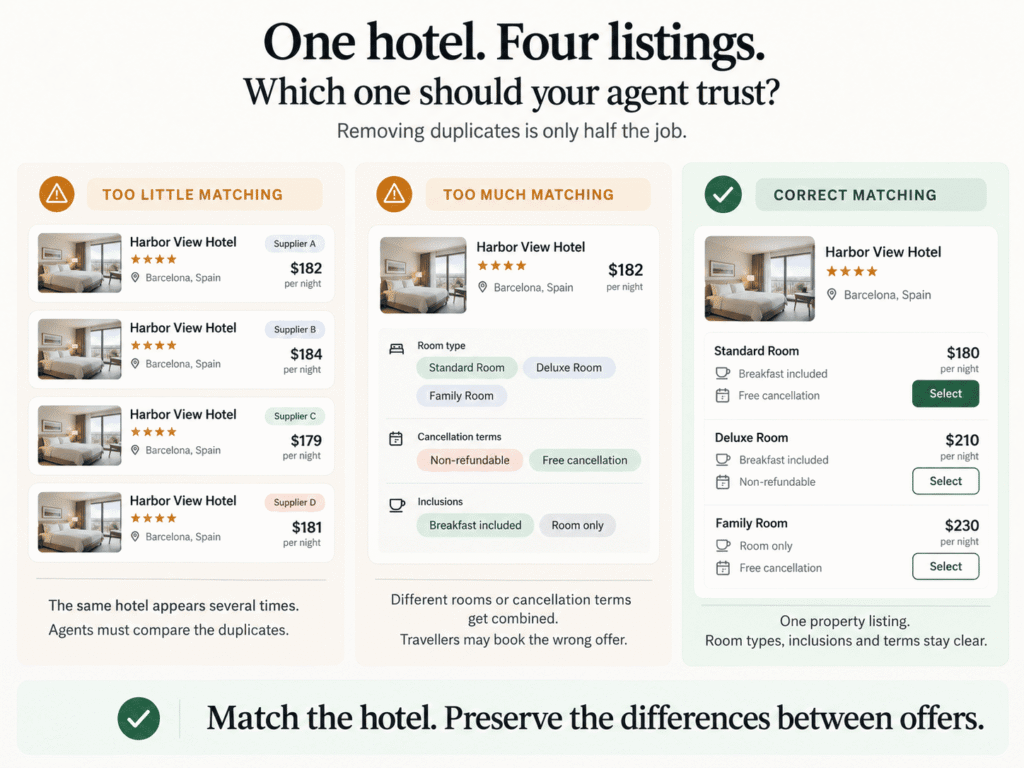
Hotel rate mapping is the process of deciding that content arriving from different suppliers describes the same property and the same room. It is the single hardest part of running a hotel booking engine and it is the reason agents lose confidence in one.
The difficulty is that suppliers do not agree on anything. The same hotel may be The Grand Hotel to one supplier and Grand Hotel & Spa to another, at addresses written two different ways, with coordinates that differ by a hundred metres. An engine maintains a mapping table linking the same property across suppliers, built from supplier-provided mapping files and matched on address and coordinates where those files fall short.
Room mapping is harder again. Deluxe King with Breakfast from one supplier and Deluxe Room, 1 King Bed, BB from another may be the same room or may not be. Board basis, bed type, occupancy and rate conditions all have to line up before two rooms can be shown as one.
Two failure modes, and both are expensive.
Under-mapping leaves duplicates. The same hotel appears four times at four prices and the traveller cannot tell whether they are choosing between hotels or between suppliers. Agents stop trusting the list and go back to calling the hotel.
Over-mapping merges things that are not the same. A room with free cancellation gets merged with a non-refundable one at a lower price, the engine shows the cheaper rate, and the cancellation terms the traveller agreed to are not the terms they get. This surfaces as a complaint rather than as a bug, which is why it often goes undiagnosed for months.
If you are evaluating engines, this is the area to probe hardest, because it is the area where every vendor says yes.
What makes a corporate hotel booking engine different
Most hotel booking engines on the market are built for leisure and B2B resale. A corporate hotel booking engine has three requirements those do not, and retrofitting them is difficult.
It has to carry the client’s own rates. A corporate client has negotiated rates with specific hotels. Those rates have to appear alongside aggregated supplier content, for that client only, and they have to win where they should. A leisure engine has no concept of rates belonging to one customer.
It has to rank by policy, not price. The cheapest room is often not the bookable one. Grade entitlements, preferred properties, city caps and safety requirements all come before price. The engine needs to know who the traveller is before it can sort results properly, which means it needs profiles and policy, not just search.
It has to produce auditable records. Every booking needs to reconcile later, carry a cost centre, and appear correctly in the client’s quarterly spend review. A leisure engine is finished when the voucher is issued. A corporate engine is finished when the invoice reconciles.
The cost of getting this wrong is measurable. GBTA’s 2026 study puts around 32% of hotel bookings outside the managed channel, with 72% of buyers naming “I found it cheaper somewhere else” as the top traveller complaint and 38% naming rate clarity. The usual cause is not defiance. It is an engine that shows a bare number without the inclusions, so a negotiated rate with breakfast and parking loses to a cheaper public rate without them.
That is a display and ranking failure, not a sourcing failure, and it happens inside the booking engine.
This is why a hotel engine sold to OTA startups and a hotel engine sold to TMCs can look identical in a demo and behave completely differently in production.
How corporate negotiated hotel rates get loaded, and lost
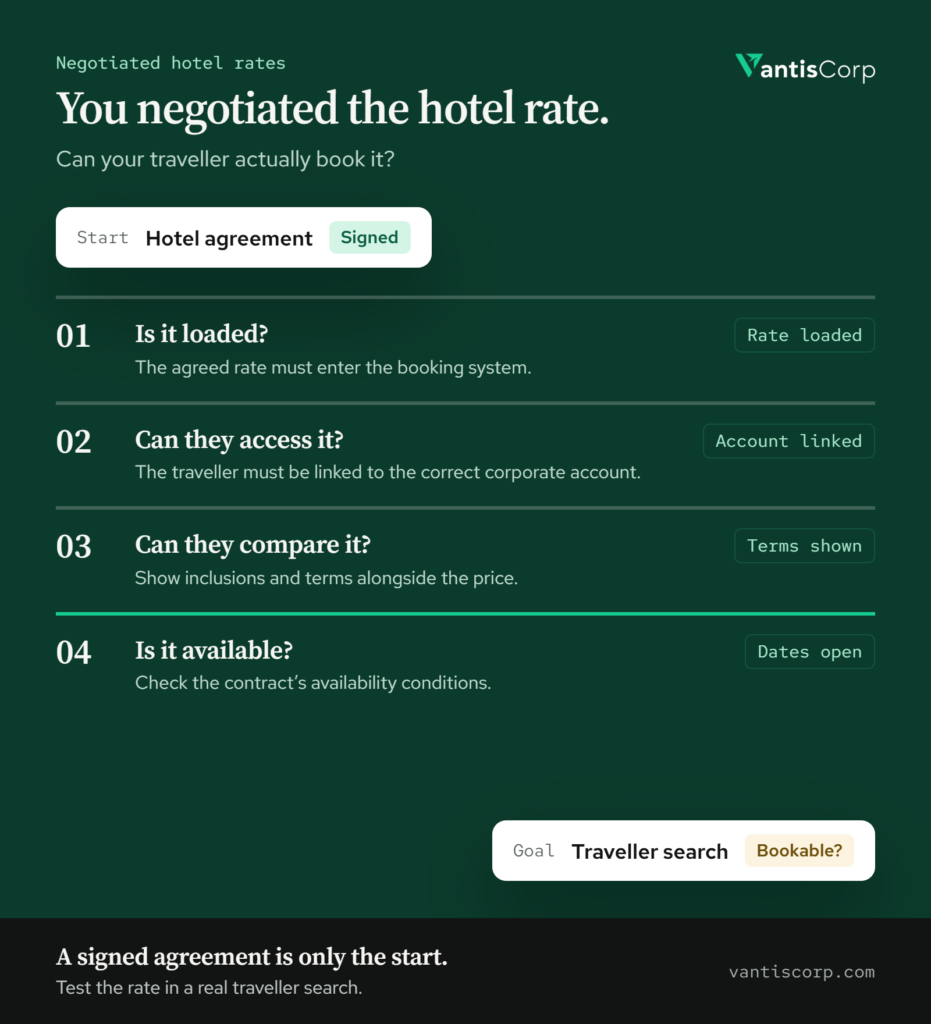
Negotiated rates are the part corporate clients care most about and the part most likely to be quietly broken.
The rate exists because the client’s travel manager negotiated it, usually during an annual RFP cycle. It then has to be loaded so that it appears in the booking flow for that client’s travellers and nobody else’s. Depending on the source, that means a rate code in the GDS, a direct contract loaded into the engine, or a chain’s own system recognising the client.
Four things commonly go wrong, and the first two are measured. BCD Travel’s 2025 Hotel Industry Report found 18% of negotiated rates fail to load correctly into the GDS at contract start, and 11% of properties charge above the negotiated rate at least once during the contract year. Nearly one rate in five is wrong from day one.
The rate never gets loaded for the new contract year, so travellers quietly book public rates for three months. It loads but does not display, because the traveller profile is not linked to the right client account. It displays but loses to a cheaper public rate the engine ranks above it. Or it is available only when the chain has rooms left in that bucket, which is the last room availability question, and nobody has checked whether the contract includes it.
None of those produce an error message. They produce a client asking at the quarterly review why their negotiated rate usage is down, which is a much worse way to find out.
We cover the loading process and the failure modes in detail in our guide to corporate hotel programmes.
White label hotel booking engine: what to check before you sign
White label means the engine carries your brand on the front while someone else owns the infrastructure behind it. That is a reasonable trade and it is worth understanding exactly what you are trading.
Six questions worth asking, in rough order of how much trouble a bad answer causes.
- Who owns the supplier relationships? If the provider holds the contracts, your content and your rates change when their contracts change. That is not automatically wrong. It is something to know.
- Who owns the booking record and the client data? This matters for reporting, for reconciliation, and for what happens if you leave.
- How is rate and room mapping handled, and by whom? Ask specifically about duplicate handling and about room-level matching, not just property-level.
- Can it carry per-client negotiated rates? If the answer involves a workaround, it was built for leisure.
- What control do you have over the booking flow and the display? White label ranges from your logo on their page to genuine control over layout and logic.
- How does it hand off to mid office and back office? An engine that does not feed your ticketing and reconciliation cleanly creates a new manual join rather than removing one.
One more worth asking plainly: what happens at renewal. A booking engine is not a system you can swap over a weekend.
From search to voucher: how a booking actually completes
Useful to walk once, because most of the failure points are invisible from the front end.
| Step | What happens | Where it breaks |
|---|---|---|
| 1. Search | Query fans out to every connected supplier at once | Slow supplier holds up the whole response |
| 2. Merge | Duplicate properties and rooms are matched and combined | Under-mapping shows duplicates, over-mapping shows wrong terms |
| 3. Rank | Results sorted by policy, preference and price | Negotiated rate ranked below a public one |
| 4. Price | Markups, fees and taxes applied, currency converted | Price changes between results page and checkout |
| 5. Hold | Rate rechecked against the supplier before confirmation | Cached rate no longer available, traveller sees a failure |
| 6. Book | Supplier confirms, voucher issued | Confirmation received but not written back to the booking record |
| 7. Hand off | Booking flows to mid office and back office | Re-keyed by hand, which is where the real cost sits |
Step 5 is worth dwelling on. Engines cache supplier responses to keep search fast, which means the price on the results page is a recent price rather than a live one. Every engine does this and the question is not whether it caches but how it behaves when the cached rate has gone. A good engine rechecks and tells the traveller clearly. A poor one fails at confirmation and sends the agent back to the start.
Should a TMC build or buy a hotel booking engine?
Buy the content layer. Own the logic on top of it.
Building supplier aggregation from scratch means contracting individually with bedbanks, wholesalers and chains, then maintaining an integration per supplier, then building and continuously maintaining a mapping table across all of them. That is a permanent engineering commitment, and it is a solved problem that specialists maintain full time.
What is worth owning is everything that makes the engine yours: policy rules, traveller profiles and grades, client-specific negotiated rates, approval flows, and the joins into your mid and back office. That is where a corporate engine differs from a leisure one, and it is the part no supplier will do for you.
The honest version most vendors will not say out loud: almost nobody in this market builds their own hotel content layer, including the vendors selling you one. Content and mapping come from specialists. The question is not whether a provider built it themselves, it is whether they are clear about who did.
What a hotel booking engine cannot do
Three limits, and knowing them prevents disappointment.
It cannot create content you do not have access to. If a property is not distributed through any of your suppliers, no engine will surface it. Coverage is a contracting problem, not a software one.
It cannot fix a negotiated rate that was never loaded. The engine displays what exists. Rate loading is a programme management task that happens before the engine is involved.
It cannot replace your mid and back office. An engine produces bookings. Quality control, ticketing where relevant, invoicing and reconciliation all happen elsewhere, and the join between them has to be built deliberately.
Where VantisCorp fits
Our hotel booking engine is one of four parts of the platform, and it is white-labelled, so your corporate clients only ever see your brand.
On content, we connect through an aggregation layer covering bedbanks, wholesalers, GDS and channel managers rather than holding individual supplier contracts, and we use a specialist room mapping service so the same property from four suppliers appears once with its rooms correctly grouped. We would rather tell you that than imply we built a mapping engine from scratch, because the first technical conversation would uncover it anyway.
What we do own is the corporate layer. TMCs set up each corporate client in the portal with their travel policy, employee grade entitlements, suppliers and tied-up hotels, instead of keeping that in spreadsheets and PDFs. When an agent searches for a traveller, results show that corporate’s own negotiated prices alongside aggregated content. There is a corporate booking tool for your agents and a self-booking tool for your clients’ employees, both reading the same policy and profile data.
The bookings then feed our mid office and back office, so the handoff from booking to invoice is not a re-keying job.
One boundary, stated plainly. Our AI Quote Agent reads corporate travel requests from an inbox and returns flight and hotel options for an agent to approve. That is the AI part of our platform. The booking engine, mid office and back office are conventional software and we do not describe them otherwise.
Frequently asked questions
How does a hotel booking engine work?
It queries several hotel suppliers at once, merges duplicate properties and rooms into a single list, applies your pricing and policy rules, then holds and confirms the booking and issues a voucher. The merging step is the hardest part and the one that most affects whether agents trust the results.
What is a white label hotel booking engine?
An engine that runs under your brand while a provider owns the infrastructure, supplier connections and often the booking record behind it. Your travellers see you. The questions worth asking are who holds the supplier contracts and who owns the data.
Why does the same hotel appear multiple times in search results?
Because different suppliers returned it under slightly different names, addresses or coordinates and the mapping did not match them. That is under-mapping, and it is the most visible sign of a weak content layer.
What is the difference between bedbank and GDS hotel content?
Bedbanks contract rooms in bulk and resell them through an API, usually at net rates with strong independent and leisure coverage. GDS hotel content comes from chain systems alongside air content and carries corporate negotiated rate codes, with coverage weighted toward chains.
Can a hotel booking engine show a client’s negotiated rates?
A corporate engine can and must. A leisure engine usually cannot, because it has no concept of rates belonging to one specific customer. This is the clearest dividing line between the two types of product.
How long does it take to launch a hotel booking engine?
Ask providers for time to first live booking rather than time to go-live, and ask separately how long supplier content and negotiated rate loading take. Those are usually the long poles, not the deployment.
Conclusion
Judge a hotel booking engine on its content layer, not its search screen. Ask how property and room mapping work, ask what happens when a cached rate disappears at confirmation, and ask whether the engine can carry one client’s negotiated rates and rank by policy rather than price. If it cannot do that last part, it was built for leisure and you will spend years working around it. Buy the aggregation and mapping, because specialists maintain it better than you will. Own the policy, profile and booking logic on top, because that is the part your corporate clients are actually paying you for.
Talk to VantisCorp about your TMC
See how the workflows in this article could work for your operation. Share a few details and our team will follow up.
