

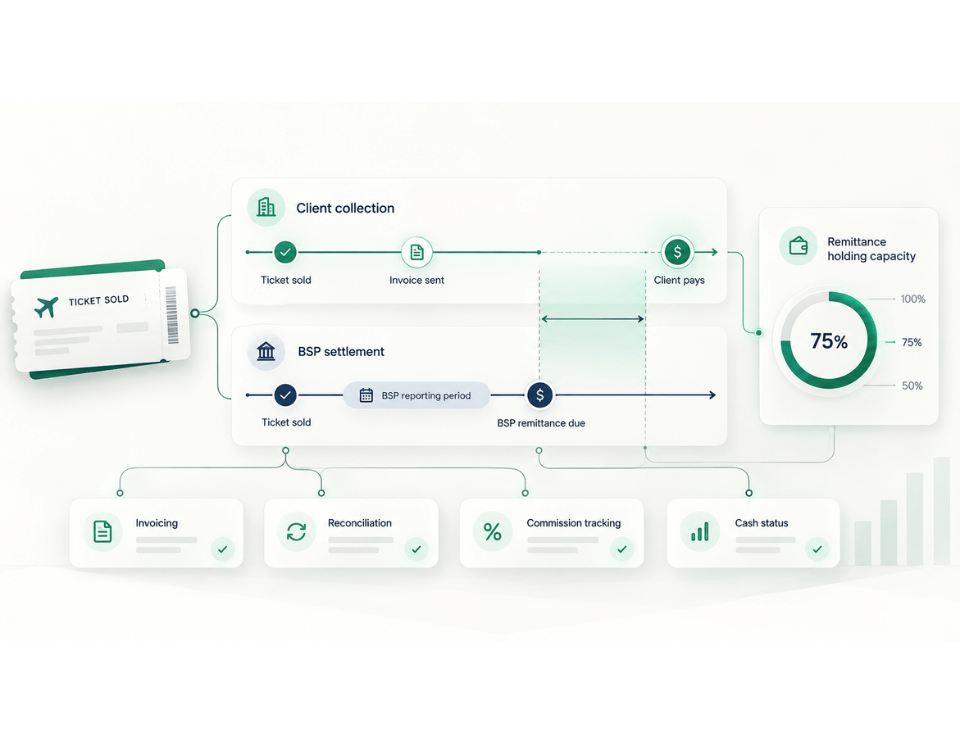
Travel agency back office automation covers everything that happens after a booking: invoicing, BSP and card reconciliation, commission tracking, debit memo handling, ledgers and client reporting. Most agencies treat it as an admin saving. For an IATA-accredited agency it is a cash flow control, because your settlement obligation runs on a fixed calendar whether your client has paid you or not.
Key takeaways
- BSP remittance is calendar-driven and does not wait for your receivables. You owe on the remittance date regardless of whether the corporate client has paid.
- IATA caps your outstanding unremitted sales through a Remittance Holding Capacity, and notifies you at 50%, 75% and 100% of it. If your back office cannot tell you where you sit against that cap in real time, IATA tells you instead.
- In November 2025 the Passenger Agency Conference removed the ability of weekly-remittance markets to choose their remittance day, standardising it at five working days after the billing period closes.
- Debit memos are the one automation outcome you can audit. Every common ADM reason code is a data quality failure upstream.
- For a TMC specifically, the back office produces the client reporting that renewals are argued over. It is a retention system, not just a finance system.
What does travel agency back office automation cover?
Back office is everything the client never sees and every auditor eventually does. Invoicing and customer ledgers, supplier and BSP reconciliation, commission and markup calculation, debit memo handling, multi-currency accounting, and the management reporting that comes out of all of it.
The distinction from mid office is worth getting right, because vendors blur it. Mid office sits between the booking and the ticket: quality control, file finishing, policy checking, ticketing. Back office starts after the ticket exists and deals with money. Ask a vendor whether they do back office and you will get a yes from products that mean very different things by it.
One thing back office is not is a replacement for your accounting software. The pattern that works is a travel-specific system handling the travel-specific reconciliations, exporting cleanly into a general ledger package for statutory accounts. Agencies that try to run statutory accounting inside a travel back office, or travel reconciliation inside a general accounting package, end up doing both badly.
Why back office automation is a cash flow problem, not an admin one
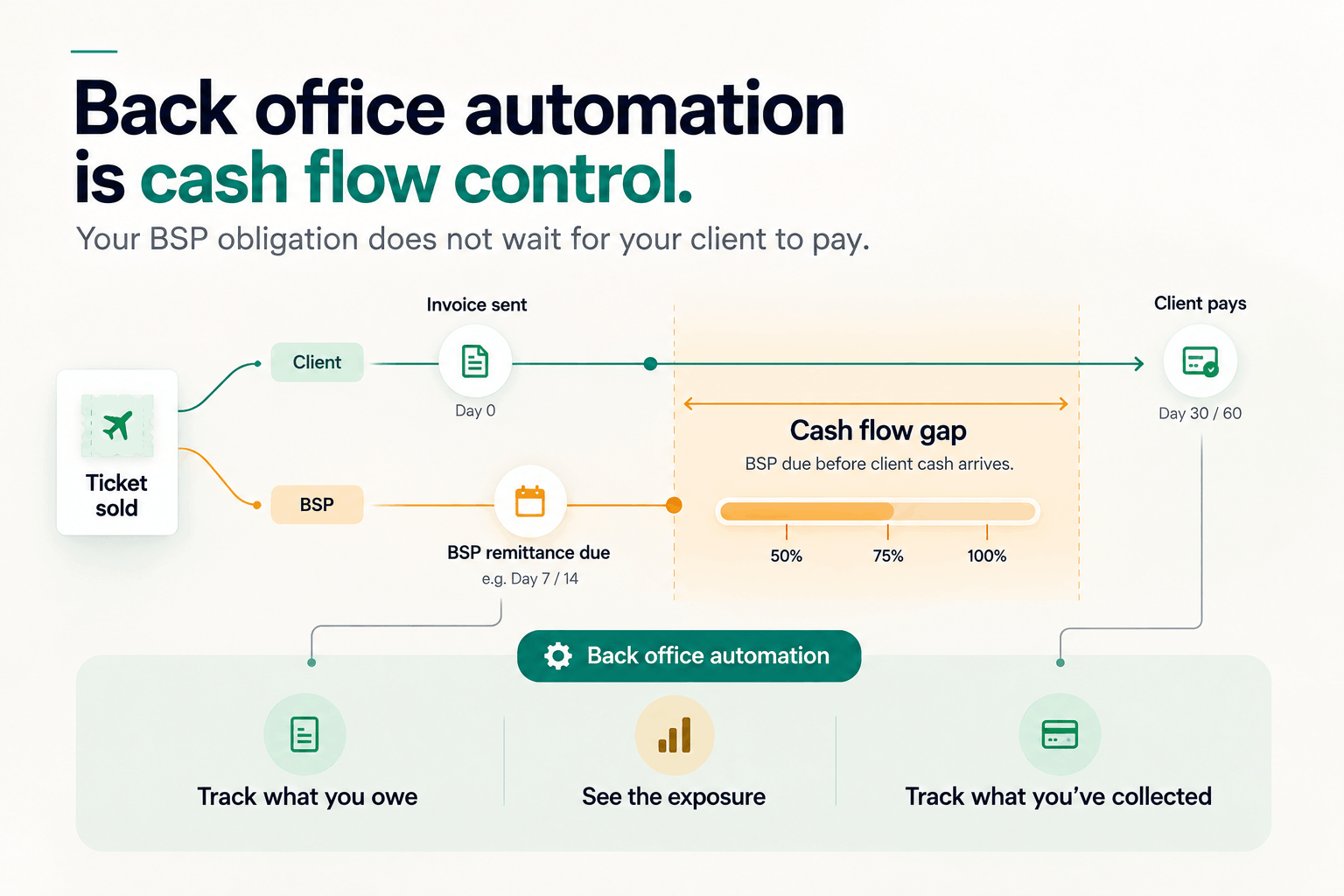
Here is the framing almost every article on this subject misses, and it is the one that matters if you are IATA-accredited.
You sell a ticket today. Your corporate client pays you on thirty or sixty day terms. But your obligation to the airlines runs on a calendar set by IATA, not by your receivables. As the BSP Manual for Agents sets out, remittance frequency is fixed for each BSP market and the exact dates are published annually in a remittance calendar. Miss one and you are in default, regardless of who owes you what.
That gap is where agencies fail. As one finance-led guide to accreditation puts it, you may collect the customer’s money today and not owe BSP until a future settlement date, and the danger is that the cash gets used to fund operating expenses before settlement falls due.
IATA knows this, which is why it caps you. The cap is called your Remittance Holding Capacity. It is the most you are allowed to owe BSP at any one time before you have paid. IATA works out that number from either the security you have lodged or your busiest three reporting periods in the last year, and then watches your sales and warns you at 50%, 75% and 100% of it.
That is the whole argument for automating your back office, in one sentence. If your systems cannot tell you where you sit against that cap today, IATA will tell you first. By then your choices are to stop selling, put up more security, or pay early.
The calendar also got tighter. In November 2025 the Passenger Agency Conference amended Resolution 812 so that markets on weekly remittance must transfer funds five working days, or seven calendar days, after the billing period closes, ending the ability of those markets to choose which day remittance falls on. Of the 134 BSP markets on a weekly schedule, 108 had already aligned over the preceding two years. The rest lost a flexibility they had been using.
So the real question your back office has to answer is not how many hours it saves. It is: what do we owe, when, and have we collected it yet.
BSP reconciliation and the errors that cost most
BSP reconciliation means matching what your systems say you sold against what the settlement plan says you owe. Done manually it is a finance team spending days comparing booking records to BSP statements. Done properly it runs as a comparison, flags discrepancies, and produces a settlement record nobody has to re-check.
The volume makes the case. IATA operates BSP across settlement volumes reported at over $400 billion annually, and in the US market ARC processes over $100 billion in agency air sales each year across roughly 9,880 agency locations. At that scale a small percentage error rate is a large number.
The errors that cost most are not the obvious ones. A missing transaction gets spotted. What does not get spotted is a booking that lands in the wrong period, a refund processed without pulling back the commission, or a low-cost carrier ticket that never entered the reconciliation because it settles outside BSP.
This is why the useful output of a reconciliation run is not the matched list. It is the exception list. In VantisCorp, that list is what an operator opens each morning: what did not match, why, and against which booking. Everything that reconciled cleanly needs nobody.
One warning about scope. Some agencies buy air settlement reconciliation they will never use, because their mix is mostly hotel and rail. Check your own transaction mix before paying for BSP functionality.
We cover the specific failure modes separately in our guide to BSP reconciliation errors.
Why agency debit memos are the number you can audit
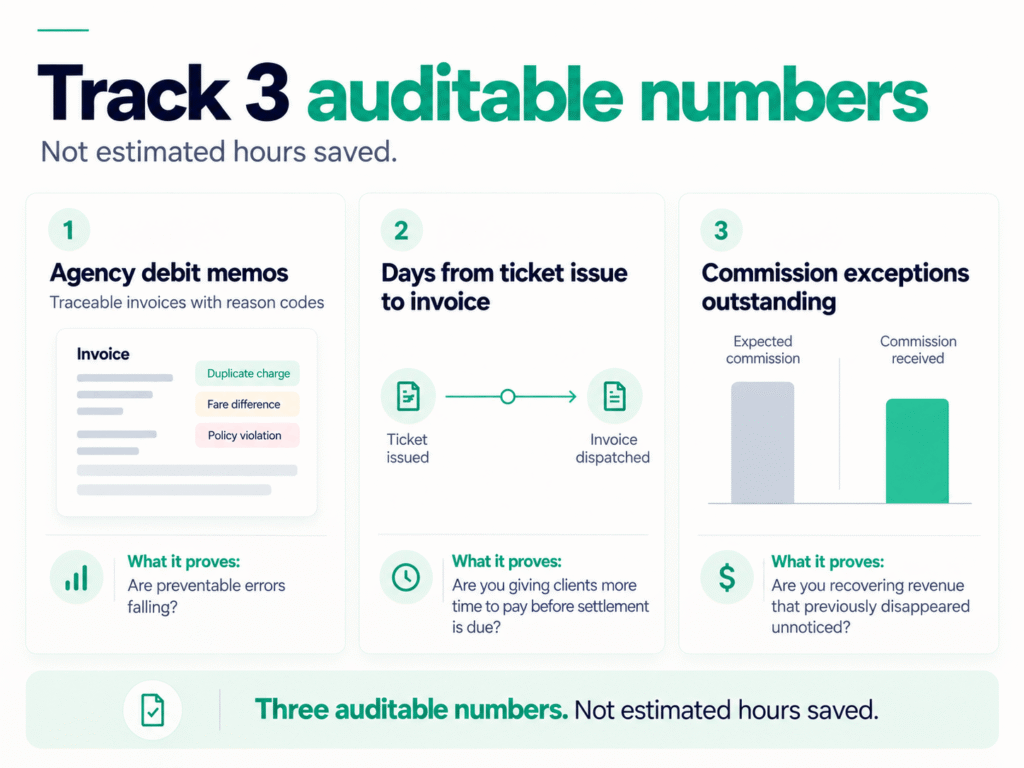
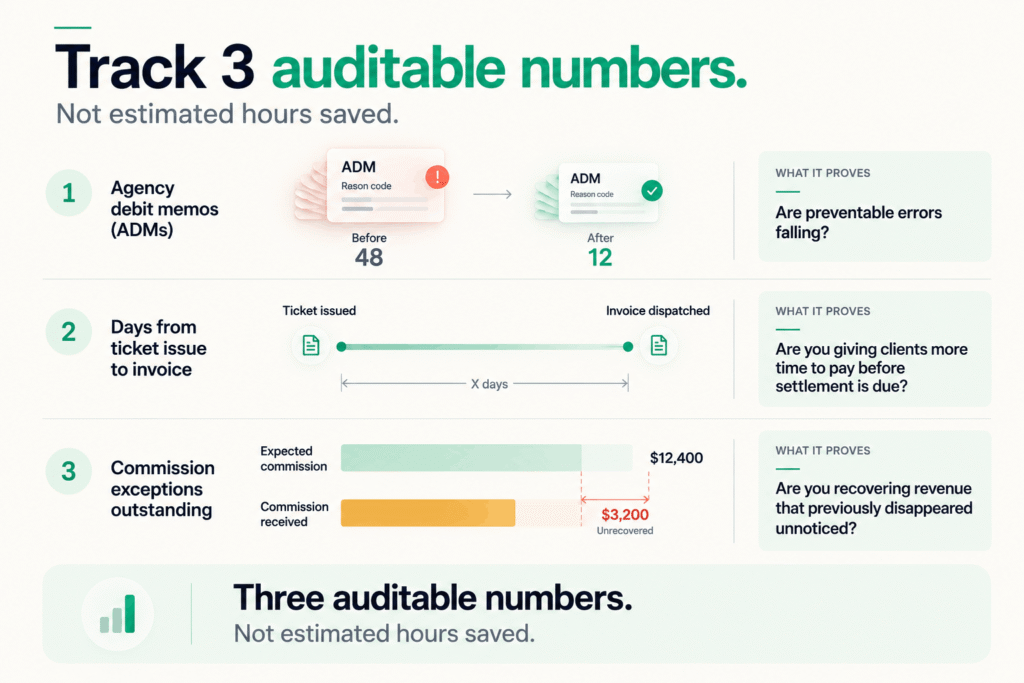
Most automation business cases are built on hours saved. Hours saved is soft. Nobody can verify it twelve months later and no finance director has ever been convinced by it.
Debit memos are the opposite. An ADM is an invoice from an airline with a reason code attached, arriving in BSPlink whether you expected it or not, and it is recorded. That makes it the one automation outcome with an audit trail.
Look at what triggers them. Carriers raise ADMs for incorrect fare calculation, wrong ticketing, under-collected taxes, incorrectly claimed commission, class mismatch, and reissue or refund errors. Every one of those is a data quality failure that happened before settlement. Which means your ADM volume is a direct measure of how well your mid and back office are working together.
Count them by reason code for six months. Automate. Count again. That is your return, in cash, with a reference number against every line. We go into the dispute process and reason code analysis in our guide to agency debit memo management.
How does invoicing automation close the receivable gap?
Invoicing automation matters more than it sounds, because the days between ticket issue and invoice dispatch are days added directly to your cash flow gap. If your remittance date is fixed and your invoice goes out a week late, you have shortened your own collection window by a week for no operational reason.
Automated invoicing raises the invoice from the booking record at the moment of ticketing, rather than from a batch someone runs on Friday. For corporate accounts it also handles the parts that make travel invoicing awkward: one monthly bill covering many travellers, cost centre splits, more than one currency, and credit limits on client or sub-agent accounts.
VantisCorp generates the invoice off the same booking record the reconciliation reads. That is deliberate. Two systems holding two versions of the same booking is how invoice disputes start.
The second-order benefit is dispute reduction. An invoice generated from booking data matches the booking. An invoice re-keyed from a spreadsheet occasionally does not, and a client who finds one error starts checking all of them. Every hour spent defending an invoice is an hour not spent collecting it.
If you only measure one thing here, measure days from ticket issue to invoice dispatch. It is usually worse than anyone assumes.
Commission tracking: the money agencies leave behind
Commission is the quietest leak in a travel agency, because unclaimed commission never appears as a loss. It simply does not arrive, and nothing in your accounts flags an amount you never invoiced for.
Three things go wrong. Commission earned on hotel and ancillary bookings never gets tracked to a claim. Override and volume-based commission gets calculated on incomplete data because the underlying booking records sit in different systems. And commission on tickets that are later refunded or exchanged gets recalled by the carrier without the corresponding adjustment being made on your side, which turns into a debit memo.
That last one connects directly to the section above. Incorrect commission recall on refunds is a standard ADM category, so commission tracking is not only a revenue question. Getting it wrong costs you twice.
Automated commission tracking compares what you should have been paid against what actually arrived, then lists the gaps. The list is the point. Working out your expected commission is easy. Chasing the shortfall is not, because chasing it means knowing exactly which bookings are short.
VantisCorp holds the expected value on each booking and flags the ones where the money never came in, by supplier. A supplier that is consistently short shows up as a pattern rather than as a hunch.
What does corporate travel reporting do for client retention?
For a TMC this is where back office stops being a finance function. The reporting you give a corporate client is the artefact they judge you on at renewal, and it comes out of your back office data.
A corporate travel review typically covers total spend by quarter, flight spend broken down by region, airline and travel class, hotel spend by property and city with nights and cost, and increasingly carbon emissions per quarter, as one corporate travel platform describes its own client reporting. Clients use those numbers in their own supplier negotiations, which is exactly why they care about them.
Here is the operational consequence. If your back office data is clean, that report is generated. If it is not, somebody spends two days a quarter per account rebuilding it in a spreadsheet, and the version the client receives is a version nobody can reproduce.
Here is what that means day to day. If your back office data is clean, the report is generated. If it is not, someone spends two days a quarter per account rebuilding it in a spreadsheet, and the version the client gets is one nobody can reproduce next quarter.
This is the case for reporting that runs off your live ledger rather than off an export. VantisCorp builds the client review pack from the same booking and invoice records the reconciliation uses, so the spend figures in the review match the invoices the client already has. Nobody has to defend a difference between two versions of the same number.
How do you evaluate back office software for a travel agency?
Ask six questions and the field narrows quickly.
- What does it reconcile automatically, and what does it hand back?
Every platform says automated reconciliation. Ask specifically about low-cost carriers, non-BSP suppliers, hotel commissions and refunds, which is where the exceptions live.
- How does it export to our accounting package?
The answer should be a named integration, not a CSV. This is the join that breaks most often.
- Can it tell us our position against our Remittance Holding Capacity?
Almost nothing does this natively and it is worth asking, because the ones that have thought about it have thought about cash flow generally.
- What does implementation actually involve?
Ask for the elapsed time from contract to first clean settlement period, not to go-live. Those are different dates.
- How does it handle multi-entity and multi-currency?
Relevant if you operate across markets, and expensive to retrofit.
What happens to our historical data? Migration scope is where back office projects overrun.
One practical note on go-live. Reconcile your first closure line by line before trusting the automation. Every implementation has a set of assumptions in it that nobody stated, and the first settlement period is where they surface.
What back office automation cannot do
Three things, and being straight about them saves disappointment.
It cannot fix upstream data quality. If ticketing produces errors, automated reconciliation will process them faster. This is why mid office quality control comes before back office automation in any sensible sequence, and why doing it in the other order produces automated errors at speed.
It cannot replace statutory accounting. Travel-specific reconciliation and statutory accounts are different jobs. Expect to run both and connect them.
It cannot decide your credit policy. Software can enforce a credit limit on a sub-agent or a corporate account. Deciding what that limit should be, and whether to extend it for a client you want to keep, is a commercial judgement and stays with you.
Where VantisCorp fits in back office automation
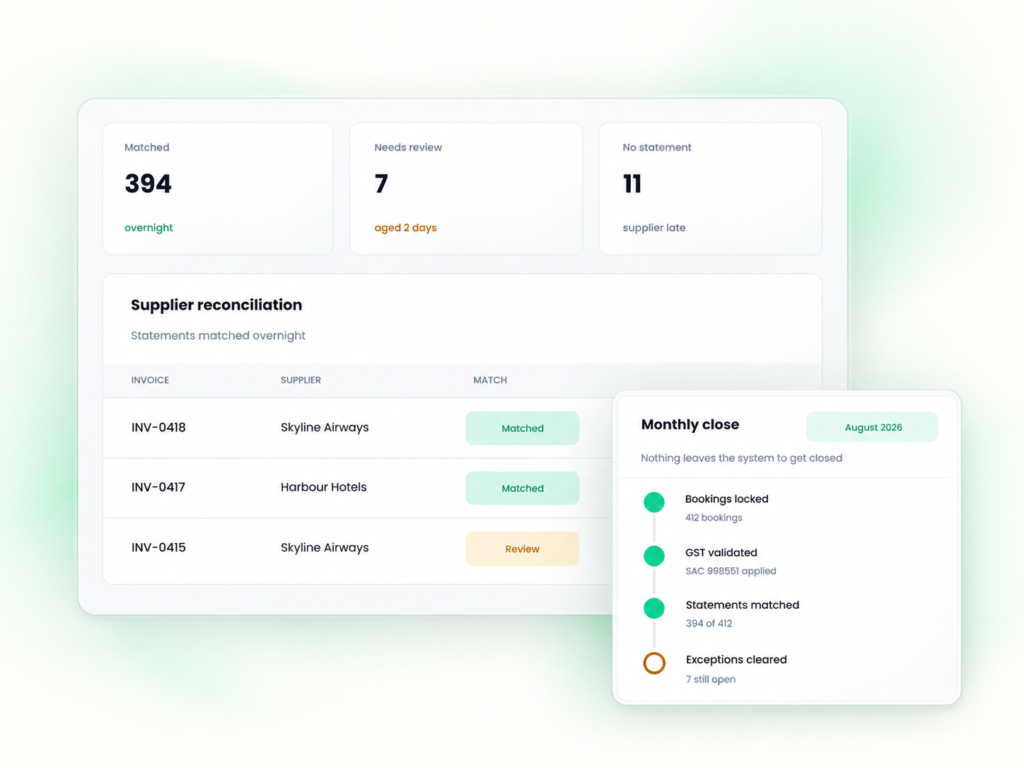
We build back office automation for TMCs, white-labelled, so your corporate clients only ever see your brand.
On the back office side that covers invoicing generated from booking data, reconciliation with exception reporting, commission tracking against expected values, ledger management for corporate and sub-agent accounts, and the reporting that feeds client reviews. It exports into your accounting package rather than trying to replace it.
Two things we would rather tell you before a demo than after. First, back office automation on top of a messy mid office produces faster errors, so if your ticketing quality is the real problem we will say so. Second, our booking agent, which reads corporate travel requests from an inbox and quotes back, is genuinely AI. Mid office and back office are conventional automation and we do not describe them otherwise, whatever the rest of this market has started calling rule-based reconciliation.
Frequently asked questions
What is the difference between mid office and back office in a travel agency?
Mid office sits between the booking and the ticket: quality control, file finishing, policy checking and ticketing. Back office starts once the ticket exists and handles money: invoicing, reconciliation, commission, debit memos, ledgers and reporting. They are operational layers rather than single products, and most platforms cover parts of both.
Does back office software replace accounting software?
No. The working pattern is a travel-specific back office handling travel-specific reconciliations and exporting into a general ledger package for statutory accounts. Treating one as a substitute for the other is a common and expensive mistake.
How long does a back office implementation take?
Ask vendors for time from contract to first clean settlement period rather than to go-live, because those are different dates. Data migration and the first reconciliation closure are where the time goes, and both are worth reconciling manually before you trust the automation.
What is the Remittance Holding Capacity?
It is the maximum value of outstanding cash sales an IATA-accredited agent may have pending remittance, calculated from financial security or from cash turnover in the three highest reporting periods of the previous twelve months. IATA monitors it and notifies agents as they approach the limit.
How do you measure the return on back office automation?
Debit memo volume by reason code before and after, days from ticket issue to invoice dispatch, and the value of commission exceptions recovered. All three are auditable, unlike hours saved.
Do smaller agencies need back office automation?
It depends on your settlement exposure rather than your size. Settlement exposure means how much airline money you are holding, and for how long. A small agency on a weekly remittance cycle with clients on thirty-day terms is carrying real risk. An agency selling mostly on card, where the airline gets paid straight away, is carrying much less.
Conclusion
Treat back office automation as a cash flow control rather than an admin saving and every decision about it gets easier. Your remittance calendar is fixed, your Remittance Holding Capacity is monitored whether you monitor it or not, and the gap between the two is filled by whatever your systems can tell you today. Start by measuring three numbers: debit memos by reason code, days from ticket issue to invoice, and commission exceptions outstanding. Fix mid office quality before automating reconciliation, because automating a bad input only produces faster bad output. Then judge the result on those same three numbers rather than on hours anyone claims to have saved.
Talk to VantisCorp about your TMC
See how the workflows in this article could work for your operation. Share a few details and our team will follow up.
